 comparison
Xometry Alternatives for Small Business: 2026 Guide
Table of Contents
- Why Small Businesses Look Beyond Xometry
- Online CNC Machining Services: What Separates Them
- Top Xometry Alternatives Compared
- Low-Volume CNC Machining for Small Runs
- Custom Manufacturing for Small Businesses: Key Decision Points
- How to Choose the Right Platform for Your Project
- Frequently Asked Questions
Last Updated: October 8, 2026
Why Small Businesses Look Beyond Xometry
Small business owners often start with Xometry because it's well-known and easy to find, but exploring a xometry alternative small business option can reveal better fits for your specific needs. But as projects grow in complexity or volume, many discover that a xometry alternative for small business might better fit their needs, no single platform works for every project.
At VanderLab, we work directly with small business owners, product designers, and makers who need precision parts, custom signage, and fabricated components. The best xometry alternative depends on what matters most: cost, lead time, quality oversight, or working directly with your manufacturer.
The manufacturers you choose shape your production experience. A platform built for high-volume injection molding may frustrate you if you need low-volume CNC machining, and instant quotes can come at the cost of personalized attention.
Online CNC Machining Services: What Separates Them
Online CNC machining services fall into three categories, each with different strengths.
Managed platforms like Fictiv sit between you and the factory. They vet manufacturers, manage quality control, and handle logistics: you upload your CAD file, get a quote, and a team oversees production.
Direct-to-factory platforms like RapidDirect connect you straight to manufacturers. They offer instant quoting and some quality management, but the factory handles your job directly.
Marketplace networks like MFG.com let you post a request for quote and receive bids from multiple manufacturers.
Each model has merit. The right choice depends on your comfort managing suppliers, your budget, and whether you value speed or cost more.
Top Xometry Alternatives Compared
Fictiv: Quality-First Manufacturing Network
Fictiv positions itself as the quality-conscious choice for small businesses that can't afford mistakes. It uses an AI-powered quoting engine and connects you to a vetted global network of manufacturers, with real-time tracking and a comprehensive quality management system.
What sets Fictiv apart is its design-for-manufacturability feedback: upload a CAD file and the system flags potential issues before production. It supports CNC machining, 3D printing, and urethane casting, so you can explore methods for the same part.
The downside is that managed oversight costs more than direct-to-factory alternatives. Fictiv isn't the cheapest option, but teams burned by quality issues elsewhere often find the peace of mind worth it.
Best for: Small teams that prioritize quality assurance and want a dedicated team managing the manufacturing process.
Pros:
- Strong focus on quality control and technical support
- User-friendly digital interface for project management
- Design feedback catches problems before production
Cons:
- Higher pricing than direct-to-factory competitors
- Less direct control over your manufacturer
RapidDirect: Speed and Cost Balance
RapidDirect appeals to small businesses that need parts fast without sacrificing quality. It specializes in competitive pricing for small-batch production, keeps lead times aggressive, and is ISO 9001:2015 certified, meaning its partners meet formal quality standards.
Its instant quoting system gets you a price in hours, not days, and automated design-for-manufacturability feedback flags issues immediately. RapidDirect offers many materials and finishes, aluminum, steel, plastic, or exotic materials, so you're not locked into limited choices.
The trade-off is that lead times vary depending on which manufacturer gets your job. You don't always know which shop will build your parts, and if that shop is busy, your timeline shifts. Fine for flexible deadlines; a risk for urgent work.
Best for: Small businesses balancing cost and speed, looking for competitive pricing on small-batch production.
Pros:
- Highly competitive pricing for small-batch work
- Fast response times for technical questions
- Wide range of materials and finishes available
Cons:
- Lead times vary based on manufacturer availability
- Less transparency about which factory builds your parts
MFG.com: Direct Supplier Negotiation
MFG.com takes a different approach: a marketplace where you post your requirements and manufacturers bid on the work. You see who's quoting, compare capabilities, and negotiate directly.
This model works best for owners with time to manage the process who want maximum transparency. You know exactly which shop builds your parts and can evaluate their equipment, certifications, and past work. For a long-term supplier relationship, MFG.com makes building that direct connection easier.
The downside is hands-on management: fielding multiple quotes, comparing responses, and managing the relationship yourself. If you're stretched thin, this adds work, but if you have the bandwidth and want to avoid middleman markups, the savings can be significant.
Best for: Small businesses that prefer managing supplier relationships directly and want transparency about who manufactures their parts.
Pros:
- Direct negotiation with manufacturers
- High transparency about supplier capabilities
- Potential for better pricing through direct relationships
Cons:
- Requires more hands-on management than automated platforms
- Longer timeline to get quotes and make decisions
Low-Volume CNC Machining for Small Runs
Low-volume CNC machining is where small businesses often get stuck. Most traditional job shops set minimum order quantities that make sense for them but not for you.
Online services built their model around this problem.
How setup cost spreads across your order. Every CNC job carries fixed costs, programming, workholding, tool changes, first-article inspection, that don't shrink with quantity.
Repeat orders and consistency. A prototype that fits is not the same as a production run that fits.
Who owns your design. When you upload a CAD file to a network, your intellectual property travels with it.
When 3D printing beats CNC. For truly small runs, roughly 5 to 20 parts, 3D printing often wins on cost and lead time.
For a small business evaluating a xometry alternative small business solution, the goal isn't the lowest quote on a single order. It's a manufacturing relationship that holds up across the second, fifth, and twentieth order, same tolerances, same finish, same person answering when something needs adjusting.
Custom Manufacturing for Small Businesses: Key Decision Points
Choosing between platforms comes down to five concrete decisions.
First, what's your tolerance requirement? Parts accurate to within 0.001 inches require CNC machining or precision 3D printing; looser tolerances mean more options and lower costs.
Second, what's your material? Aluminum, steel, and plastic have different cost structures across platforms, and some shops excel at stainless steel but struggle with exotic alloys.
Third, how many parts do you need? One prototype is different from 100 production units, and platforms handle volume differently, some excel at prototypes, others at small production runs.
Fourth, what's your timeline? Needing parts in two weeks eliminates some options; waiting six weeks expands your choices and drops costs.
Fifth, how much hand-holding do you want? Some teams want to upload a file and forget it, others want to talk through design decisions with the manufacturer.
| Decision | Priority | Impact on Choice |
|---|---|---|
| Tolerance requirement | High | Determines manufacturing method (CNC vs. 3D print) |
| Material type | High | Affects cost and available manufacturers |
| Order quantity | High | Influences per-unit cost and lead time |
| Timeline | Medium | Eliminates options, affects pricing |
| Desired involvement | Medium | Shapes platform type (managed vs. direct) |
How to Choose the Right Platform for Your Project
Choosing a platform isn't a single decision, it changes as your project moves from idea to prototype to production. The provider that's perfect for a one-off prototype is often wrong for a recurring order.
Match the provider to your project stage
One-off prototype. You need a part in your hands to test fit and function. Speed and low minimums matter more than per-unit cost. Instant-quote platforms and 3D printing services shine here.
Design iteration. You're on version three or four and the design is still moving. You want fast turnaround, design-for-manufacturability feedback, and the ability to reorder a tweaked file without renegotiating.
Bridge production. The design is frozen, you need a small run to fulfill early orders or test the market, and you're not ready to commit to tooling.
Recurring production. You're reordering the same part on a schedule, so the questions change: Can the provider reproduce the part identically every time? Do they keep process documentation? Will the same shop build it, or does it rotate?
The small-business buying criteria competitors skip
Most comparison articles rank platforms on price and lead time. For a small business, five other factors often decide it:
- Minimum order quantity. Can you buy the quantity you actually need, or must you over-order to get a fair price?
- Budget and cash flow. A lower unit price isn't a win if it locks up cash in inventory you can't move. Price the order you can afford to place now.
- Support level. When something goes wrong, can you reach a person, or is it a ticket queue? A small team without a dedicated engineer benefits from more hand-holding, even at a higher price.
- Repeat-order reliability. Ask how they handle reorders: same shop, same tolerances, documented process? This is the best predictor of whether a relationship will last.
- Accountability and IP. Who is responsible if a part is out of spec, rework, refund, or nothing? And who sees your CAD files? Get the answers in writing before you upload.
A quick decision framework
| Your situation | What to prioritize | Provider type that fits |
|---|---|---|
| One-off prototype, tight deadline | Speed, low minimum | Instant-quote platform or 3D printing service |
| Design still changing | Fast reorders, DFM feedback | Platform with automated design checks |
| Small bridge run | Low-volume pricing, consistency | Short-run CNC service or direct fabricator |
| Recurring production | Repeatability, accountability, IP control | Direct relationship with one fabricator |
| Tight budget, flexible timeline | Lowest total cost | Marketplace bidding or direct negotiation |
Get quotes, then read them carefully
Get quotes from at least two sources, the spread is often wider than you'd expect, because different networks and business models price the same part differently. But don't stop at the headline number. Check what's included: shipping, inspection, finishing, and secondary operations are sometimes separate line items. A lower quote that excludes finishing can cost more overall than a higher all-in quote.
Finally, weigh the soft factors. Can you reach a real person? Will they flag a design problem before cutting metal? Will they work with you on the next order? For a small business, those questions matter more than a few dollars of difference on a single quote.
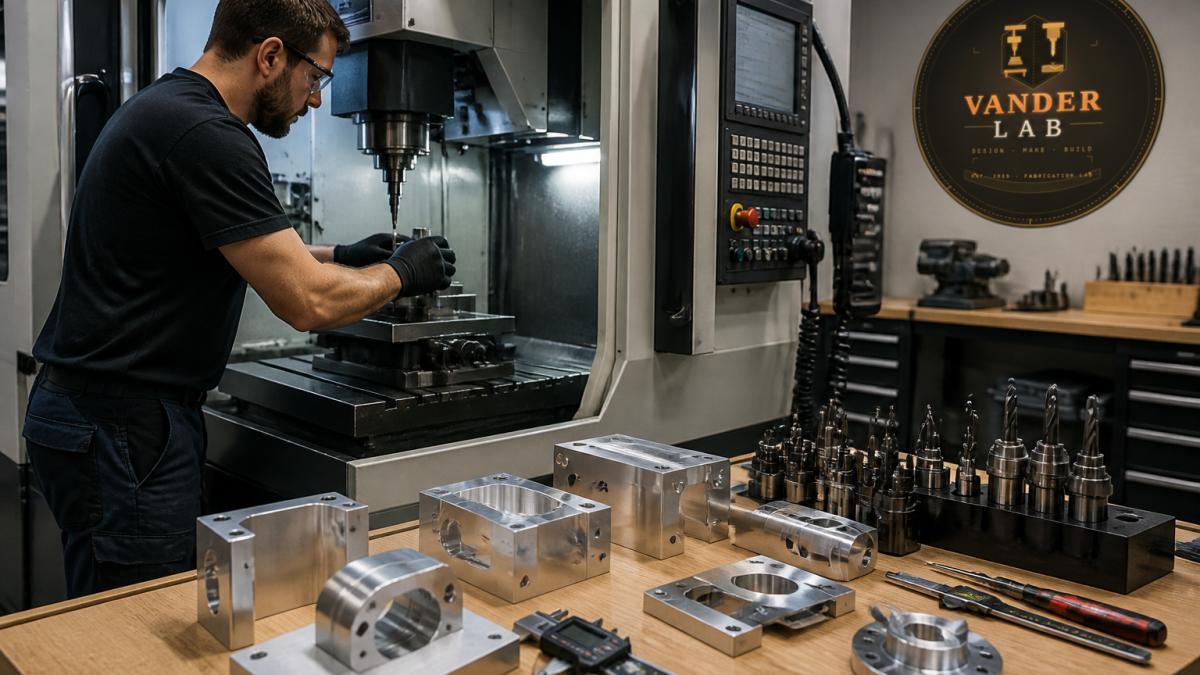
For small businesses in the Mebane area looking for custom CNC machining, custom signage, or fabricated components, VanderLab offers an alternative worth considering. We work directly with you on design, build precision parts using CNC routing and 3D printing, and deliver locally or ship nationwide. Get a custom quote through our contact form or visit our shop to discuss your needs.
Frequently Asked Questions
What should a small business compare when choosing an online manufacturing service?
Focus on three core factors: manufacturing capabilities (CNC machining, 3D printing, casting), lead times for your project volume, and quality control standards. Compare how each platform handles design feedback, material options, and surface finishes. Check whether they accept your CAD file format and offer instant quoting or require manual review. Small businesses benefit most from platforms that support low-volume runs without excessive setup costs and provide transparent communication about tolerances and production capacity.
Are there Xometry alternatives for low-volume or one-off parts?
Yes. Fictiv, RapidDirect, and MFG.com all support small-batch and prototype production. Low-volume CNC machining is ideal when you need precision without committing to large production runs. These platforms connect you to suppliers experienced in handling single prototypes through small quantities. Lead times vary, so request quotes upfront if turnaround is critical. Many also offer 3D printing as a faster, lower-cost option for initial prototypes before moving to machined parts.
How do online manufacturing platforms differ from working directly with a machine shop?
Online platforms provide instant quoting, standardized quality control, and project tracking dashboards, ideal when you need speed and consistency across multiple suppliers. Direct machine shops offer personalized relationships and may negotiate on price for repeat orders, but require more hands-on communication and longer quote turnaround. For small businesses making one-off parts, online platforms reduce friction. For ongoing production runs, direct relationships can offer better repeatability and support.
What file formats do custom manufacturing services accept?
Most accept STEP, IGES, STL, and PDF files. STEP and IGES are preferred for CNC machining because they preserve design intent and tolerances. STL works well for 3D printing. Before uploading, check the platform's requirements, some offer automated design-for-manufacturability feedback that flags issues like tight tolerances or material constraints. If your file is a sketch or photo, many services can help convert it to machine-ready CAD, though this typically adds time and cost.