 listicle
Custom Signage Solutions for Small Businesses: 2026 Guide
Table of Contents
- Quick Comparison: Digital vs. Physical Signage Options
- Types of Custom Business Signs for Every Need
- Signage Design Best Practices for Small Business Owners
- Digital Signage Software for Small Business Budgets
- Materials and Durability: What Holds Up Outdoors
- Signage Compliance and Local Zoning Laws
- DIY vs. Professional Installation: Cost-Benefit Analysis
- Measuring ROI: How Custom Signage Solutions Pay Off
- Frequently Asked Questions
Last Updated: September 16, 2026
Quick Comparison: Digital vs. Physical Signage Options
Custom signage solutions for small businesses split into two camps: physical signs that live outdoors or on a wall, and digital displays that rotate content on a screen. Physical signage still does the heavy lifting for storefront branding, wayfinding, and first impressions, while digital displays earn their keep where menus, promos, or schedules change often. This guide from VanderLab walks through both, plus the design, materials, compliance, and installation decisions that decide whether a sign lasts five years or five months.
Here's the trade-off in plain terms:
| Option | Best For | Content Changes | Upfront Effort |
|---|---|---|---|
| Vinyl banners | Events, temporary promos | Reprint required | Low |
| Acrylic and dimensional lettering | Storefront branding | Permanent | Medium |
| Digital displays | Menus, rotating promos | Instant, remote | Higher |
Types of Custom Business Signs for Every Need
The right sign type depends on where it hangs and how often the message changes. Exterior signs carry brand identity and foot traffic appeal; interior signs guide customers and drive point-of-purchase decisions.
Storefront and Exterior Signage
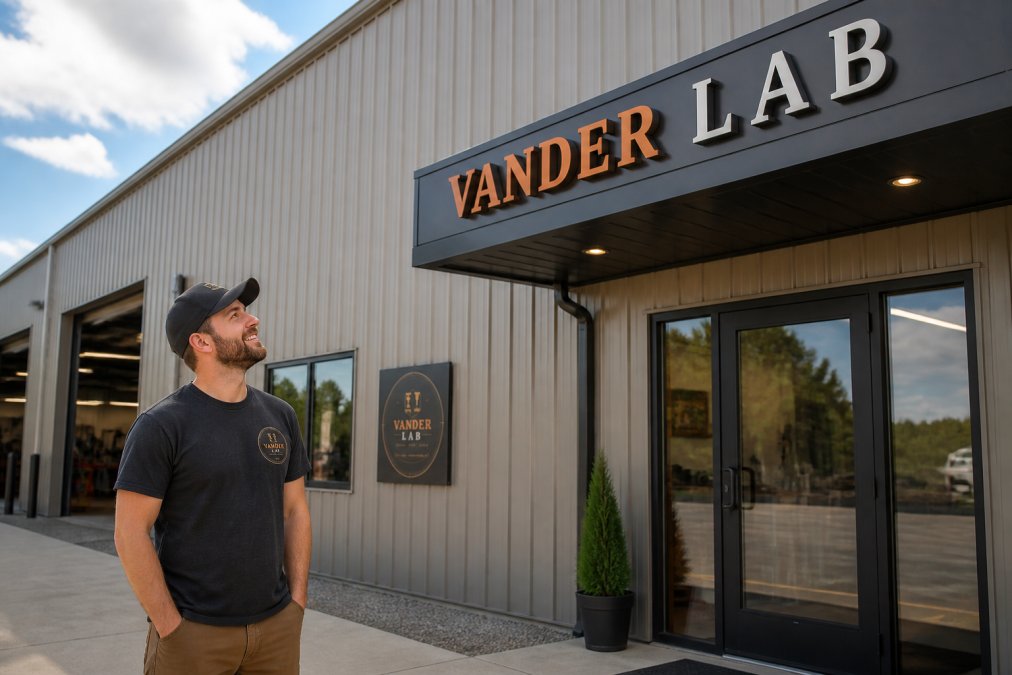
Exterior signage is the sign a customer sees before they decide to walk in. Common formats include channel letters, monument signs, window graphics, and vinyl banners for short-term use. Weather resistance and UV protection matter most here, since sun fade and rain damage are the two fastest ways an outdoor sign loses its visual impact.
Interior and Point-of-Purchase Displays
Interior signage handles wayfinding and customer engagement once someone is through the door. Acrylic signage, wall decals, and shelf-level point-of-purchase displays direct attention to products and promotions. These pieces rarely face weather, so material choice leans toward finish quality and legibility rather than durability under UV exposure.
Signage Design Best Practices for Small Business Owners
Good signage design comes down to three things: contrast, legibility, and brand consistency. A sign that's beautiful but unreadable from thirty feet is a failed sign.
Color, Contrast, and Legibility
High-contrast color pairs read best at distance. Dark text on a light background, or the reverse, beats low-contrast combinations every time. Font size should scale with viewing distance: a sign read from a moving car needs far larger lettering than one read at a doorway.
Matching Your Brand Identity
Logo reproduction should match your existing brand colors and typography exactly. Inconsistent signage, where the storefront uses one shade and the business card uses another, weakens brand identity fast. Bring reference files or a clear photo of your logo to any signage fabrication conversation.
Digital Signage Software for Small Business Budgets
Digital signage software runs a screen's content from the cloud, letting a business update menus, promos, or announcements remotely. For small budgets, the deciding factors are hardware compatibility, monthly cost per screen, and whether the software works with hardware you already own.
Several platforms serve this market well.
| Platform | Starting Price | Free Tier | Best For |
|---|---|---|---|
| Yodeck | $7.99/screen/mo | Yes | Flexible hardware options |
| Kitcast | $8/screen/mo | Yes | Apple TV users |
| Brix | $6/screen/mo | No | Lowest monthly overhead |
| OptiSigns | $10/screen/mo | No | Frequent content changes |
| Rise Vision | $10/display/mo | No | Google Workspace teams |
| ScreenCloud | $20/screen/mo | No | Advanced integrations |
| NoviSign | $20/screen/mo | No | Data-driven displays |
Materials and Durability: What Holds Up Outdoors
| Material | Typical Outdoor Lifespan | Weather Behavior | Best Use |
|---|---|---|---|
| Vinyl banner | Months to a couple of years | Fades under UV; can crack at grommets in wind | Temporary promos, events, grand openings |
| Acrylic | Many years | Holds color and gloss; can craze or yellow with low-grade stock | Storefront panels, dimensional letters, interior displays |
| Aluminum | Many years | Resists rust; finish (paint or powder coat) determines fade resistance | Monument signs, backer panels, permanent exterior |
| HDPE / PVC sheet | Several years | Won't rot or absorb water; expands and contracts with heat | Cut lettering, yard signs, moisture-heavy areas |
| Wood | Varies widely | Beautiful grain, but needs sealing and periodic refinishing | Rustic storefronts, interior feature walls, address signs |
- UV stability. Vinyl and paint fade from ultraviolet exposure, not from rain. A UV-resistant laminate or clear coat is what extends color life, and it should be specified in writing rather than assumed.
- Thermal expansion. Acrylic and PVC expand and contract with temperature swings. Mounting holes need to be slightly oversized, or the panel will crack at the fastener after a season or two.
- Wind load. A banner is a sail. Grommet spacing, hem reinforcement, and bungee-style tensioning decide whether a storm shreds it or it survives to be reused.
- Moisture and freeze-thaw. Water that gets behind a sign and freezes will pry it loose over time. Sealant at the mounting points and a small drainage gap at the bottom edge prevent that.
If a sign will face direct afternoon sun or a prevailing wind, say so before fabrication. Material and mounting choices change based on orientation, and a shop that knows the exposure can build for it.
Signage Compliance and Local Zoning Laws
Signage permits and local zoning rules are the part of this process most small business owners discover too late.
DIY vs. Professional Installation: Cost-Benefit Analysis
Most signage guides skip this decision or wave it off with 'hire a pro.' The real answer depends on four variables: what the sign weighs, what it's mounting to, whether electricity is involved, and who's liable if it fails.
When DIY Is Reasonable
- Lightweight interior pieces. Vinyl wall decals, small acrylic panels under a few pounds, and shelf-level point-of-purchase displays usually mount with adhesive strips, removable hooks, or a couple of drywall anchors.
When to Hire Out
- Anything mounted outdoors or above head height. Wind load, water intrusion, and fall risk all scale with height and exposure.
The Cost-Benefit Math
- Risk transfer. A licensed installer carries insurance for the work. If a sign falls, that matters.
- Warranty preservation. Some sign manufacturers void the warranty if installation wasn't done to spec. Read the terms before deciding.
- Lifespan. Correct anchoring and sealing extend the sign's usable life, which is where the real return sits.
- Time. A pro with the right anchors and lift finishes in an afternoon what might take a weekend of trial and error.
Measuring ROI: How Custom Signage Solutions Pay Off
Signage ROI shows up in foot traffic, customer engagement, and brand visibility rather than a single line on a spreadsheet.
Frequently Asked Questions
What website can I use to create custom signs for my business?
Several online platforms let you design and order custom signage. BannerBuzz offers templates for banners, decals, and rigid signs with a real-time preview tool. For digital displays, Kitcast and Yodeck provide cloud-based software starting around $8 per screen monthly. If you prefer working with a local maker, VanderLab in Mebane accepts custom quote requests for CNC-routed and laser-engraved pieces.
What are the most durable materials for outdoor business signage?
Aluminum and acrylic are the most durable choices for outdoor signage. Aluminum resists rust and holds up to weather, while acrylic offers a polished look with UV protection to prevent fading. Vinyl banners work well for temporary promotions but degrade faster in direct sunlight. For permanent storefront signs, powder-coated aluminum or CNC-routed PVC with UV-resistant finishes last longest.
How does custom signage improve local brand recognition?
Consistent signage builds visual messaging that customers associate with your business. A distinctive storefront sign with your logo, colors, and a clear message creates recognition before someone walks in. Repeated exposure to the same visual identity across exterior signs, window graphics, and interior displays reinforces brand visibility. Small businesses that invest in cohesive signage often see stronger foot traffic and customer engagement because people remember where they saw you.
What is the difference between CNC-routed and laser-engraved signage?
CNC routing cuts shapes and letters from solid materials like wood, acrylic, or metal, producing dimensional lettering with depth and shadow effects. Laser engraving burns designs into the surface, creating fine detail without cutting through. CNC routing suits large outdoor signs and 3D logos, while laser engraving works best for intricate patterns, small text, or personalized keepsakes. Many custom signage projects combine both methods for the best visual impact.
What are the benefits of choosing local makers for business signage?
Local makers offer direct communication, faster turnaround on revisions, and the ability to discuss your project in person. VanderLab, based in Mebane, North Carolina, builds custom signage using CNC routing and laser engraving, with local pickup available and shipping nationwide. Working with a local fabricator means you can ask questions about material specifications, see samples, and get a piece made to your exact tolerances rather than picking from a limited catalog.