 comparison
Metal 3D Printing Service: What to Know Before Ordering
Table of Contents
- What Metal 3D Printing Service Delivers
- Metal 3D Printing Materials: Which Alloys Work Best
- How Metal 3D Printing Processes Work
- Metal 3D Printing Design Guidelines for Custom Parts
- Getting an Online Metal 3D Printing Quote
- When Metal 3D Printing Is the Right Choice
- Frequently Asked Questions
Last Updated: October 21, 2026
What Metal 3D Printing Service Delivers
Metal 3D printing service transforms digital designs into solid metal parts without traditional tooling or molds. Instead of expensive setup and long lead times, it builds parts layer by layer using powder or wire feedstock and concentrated heat sources, from functional prototypes to finished production parts.
At VanderLab, precision matters. Whether you're engineering a custom bracket, prototyping a new product, or producing small batches of specialized components, metal 3D printing service offers speed and flexibility traditional methods can't match. It eliminates waste, handles geometries impossible to machine, and delivers parts ready for real-world use.
What makes a metal 3D printing service valuable isn't just the technology, it's the expertise behind it. A quote buys more than machine time: guidance on whether the process fits your part, which material performs best, and how to optimize design for strength and cost.
Metal 3D Printing Materials: Which Alloys Work Best
The material you choose determines your part's strength, weight, temperature resistance, corrosion behavior, and cost. Common metals include stainless steel, aluminum, titanium, nickel-based alloys, cobalt-chrome, and copper alloys.
Rather than pick a material first and design around it, experienced practitioners define the operating conditions, then narrow the alloy list. Here is the decision framework we use when a customer asks which metal fits their part.
Step 1, What does the part have to survive? Temperature, load, corrosion exposure, and wear are the four filters that eliminate most candidates quickly.
Step 2, What are the hard limits? Weight, conductivity, magnetic response, and biocompatibility can rule an alloy in or out regardless of strength.
Step 3, What can the process actually deliver in that alloy? Not every process runs every alloy.
Step 4, What post-processing does the alloy require? Material choice quietly drives cost and lead time.
| Material | Strength | Corrosion Resistance | Heat Resistance | Typical Fit |
|---|---|---|---|---|
| Stainless Steel | High | Excellent | Moderate | Outdoor parts, chemical exposure, general fixtures |
| Aluminum | Moderate | Good | Low | Lightweight prototypes, housings, weight-sensitive brackets |
| Titanium | Very High | Excellent | Excellent | High-performance, weight-critical, medical-adjacent |
| Nickel Alloy | Very High | Excellent | Excellent | Extreme temperatures, engine and energy components |
| Cobalt-Chrome | Very High | Excellent | High | Wear-resistant, medical and dental, high-load |
| Copper Alloy | Moderate | Good | Moderate | Thermal and electrical conduction |
- Stainless steel is the workhorse, balancing corrosion resistance, strength, and cost, and it is the alloy most providers know best. If you are unsure, stainless is usually the safe starting point.
- Aluminum saves weight and often saves cost, but it loses strength at elevated temperatures and can be trickier to finish cleanly. It shines in housings, brackets, and prototypes where mass matters.
- Titanium delivers an exceptional strength-to-weight ratio and heat resistance, but it is the alloy most sensitive to build atmosphere and post-processing. Budget for HIP and careful finishing if fatigue life matters.
- Nickel alloys and cobalt-chrome handle extreme heat and wear, which is why they show up in engines, energy hardware, and medical and dental parts. They are also the least forgiving to machine and finish.
- Copper alloys are selected for conduction, not structure. If your part needs to move heat or current, copper is the reason; if it needs to carry load, look elsewhere.
Material selection is also where design and cost meet. A part designed for titanium but built in stainless may be over-engineered and overpriced; a part designed for aluminum but pushed into a hot environment may fail early. When exploring metal 3D printing design guidelines, start with the material decision, then let wall thickness, support strategy, and tolerances follow. A provider can confirm whether your alloy will perform, or whether another would do the same job with less post-processing.
How Metal 3D Printing Processes Work
Metal 3D printing service relies on a few core technologies. The two dominant approaches are powder bed fusion and directed energy deposition.
Powder bed fusion spreads a thin layer of metal powder across a build platform, then uses a laser or electron beam to melt specific areas. The platform drops, fresh powder spreads, and the process repeats.
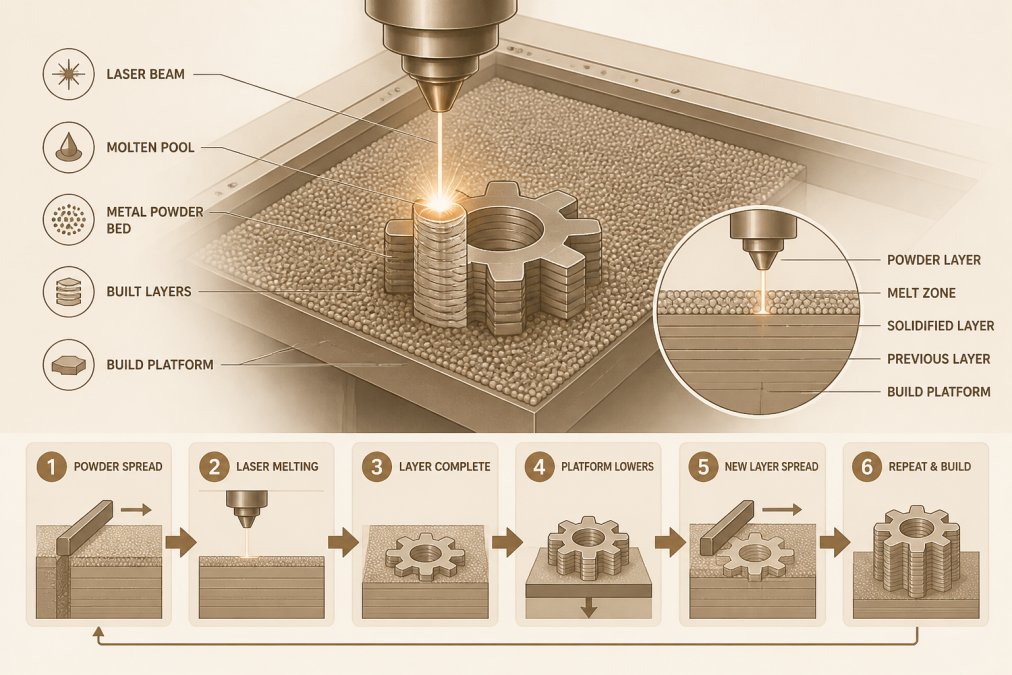
Directed energy deposition uses a nozzle that deposits metal powder or wire while simultaneously melting it with a laser or electron beam.
Both methods require post-processing. Parts come off the printer embedded in powder or support material that must be removed. Stress relief heat treatment may be necessary to eliminate internal stresses from rapid cooling.
Metal 3D Printing Design Guidelines for Custom Parts
Your design makes or breaks the result. A metal 3D printing service can build almost anything, but smart design reduces cost, improves strength, and speeds production.
Start with wall thickness. Thin walls are possible but costly, requiring careful support structures and slower build speeds. Most metal 3D printing service providers recommend minimum wall thickness around 0.8 to 1.0 millimeters for stainless steel, slightly thicker for aluminum.
Support structures are temporary scaffolding that holds your part during printing and is removed afterward. Overhangs, internal cavities, and tall thin features need them.
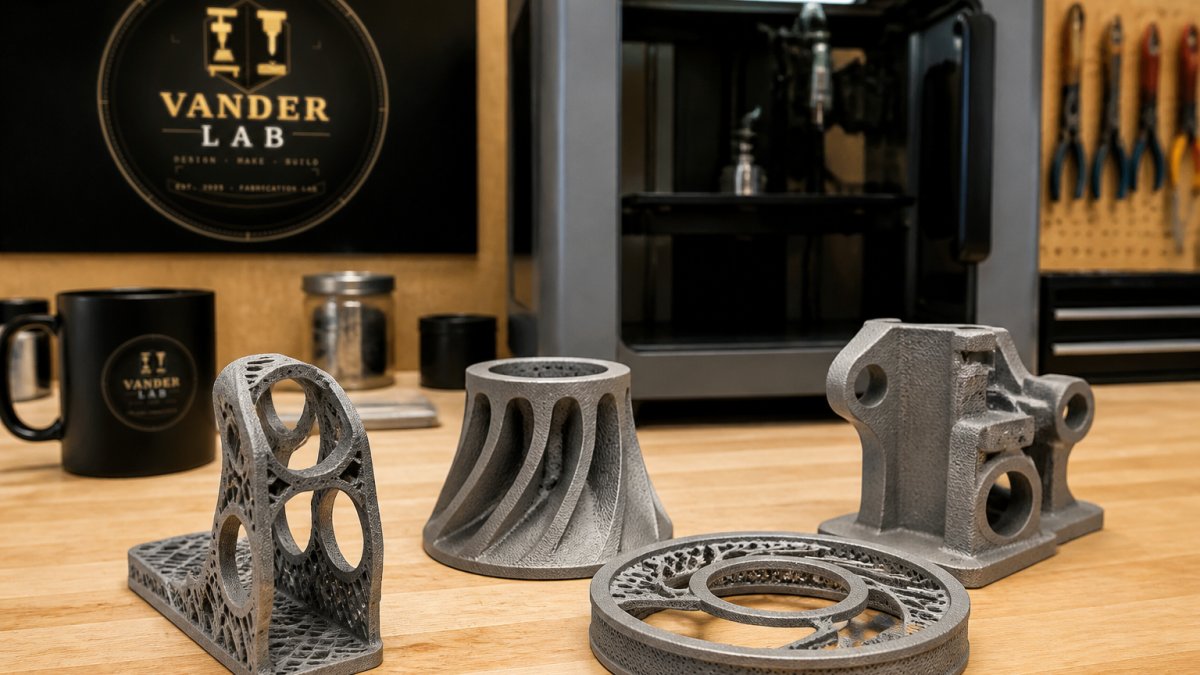
Use design complexity, that's where metal 3D printing shines. Internal cooling channels, lattice structures, and organic shapes are cheap to produce compared to traditional machining. Hollow sections, integrated fasteners, and complex internal geometries become practical.
Tolerances matter, but they cost money. Holding tight tolerances across your entire part requires careful process control and post-processing. Specify tolerances only where they're functionally necessary.
Getting an Online Metal 3D Printing Quote
Requesting a metal 3D printing quote online is straightforward. Most providers accept CAD files, STEP is most reliable, STL works for geometry-only checks, IGES for legacy files. Upload, select your material, and the system returns an estimate and lead time.
Here is what actually drives a metal 3D printing quote, in rough order of impact:
- Build height and part volume. Powder bed fusion costs scale with how tall the part is and how much of the build chamber it occupies. A tall, thin part can cost more than a compact, heavier one because build time is driven by layer count, not mass.
- Material. Premium alloys like titanium and nickel cost more per unit of powder and often require tighter atmosphere control and additional post-processing. Stainless and aluminum are the cost-friendlier end of the range.
- Support volume. Overhangs, internal cavities, and tall thin features need support structures that are built, then removed by hand or machine. Support removal is labor, and labor is a large share of a metal quote.
- Tolerances. Holding tight tolerances across an entire part requires process control and often secondary machining. Specifying tolerances only where they are functionally necessary is the single most reliable way to reduce cost without compromising the part.
- Post-processing. Stress relief, HIP, heat treatment, machining, and surface finishing each add time and cost. A part needing mirror polish or a specific surface texture carries finishing labor an as-built part does not.
- Quantity and nesting. Small batches can share a build chamber, which spreads setup cost across parts. A one-off pays the full setup; a batch of ten may not cost ten times as much.
Two parts with the same material and bounding box can land at very different quotes depending on orientation, support strategy, and how much of the tolerance budget is truly needed. A formal quote from a provider who asks about your application beats the lowest instant estimate on a portal.
How to compare quotes fairly. When you gather quotes from multiple providers, compare them on consistent criteria rather than on the headline number:
- Material and process specified. Confirm the quote names the alloy and the process (powder bed fusion vs. directed energy deposition), not just "metal."
- Tolerances stated. Ask what tolerance the quote assumes and where it applies. A quote that does not state tolerances is not comparable to one that does.
- Post-processing included. Stress relief, support removal, and finishing should be itemized. A low quote that excludes heat treatment is not actually lower.
- Inspection and documentation. Ask whether material certificates and dimensional inspection reports are included or optional.
- Lead time basis. Clarify whether the lead time is from file receipt or from quote acceptance, and whether post-processing is inside that window.
At VanderLab, we work from sketches, photos, or rough ideas if you don't have finished CAD files. We can help develop a design that is functional and cost-effective for metal 3D printing service, and our custom quotes reflect what your part actually needs rather than generic assumptions. If a design change would save meaningful cost without compromising performance, we'll tell you before the quote goes out.
Compare quotes on material, tolerances, post-processing, documentation, and lead time together. The cheapest option is rarely the best value once those are on the table, and a metal 3D printing service that understands your application will often recommend material or design changes that save money without compromising the part.
When Metal 3D Printing Is the Right Choice
Metal 3D printing service excels at certain jobs and struggles at others. Understanding the fit prevents expensive mistakes.
Metal 3D printing service makes sense for:
- Prototyping and testing: Build functional prototypes quickly without expensive tooling. Test designs before committing to production.
- Low-volume production: Small batches of 10 to 500 parts. Tooling costs make traditional manufacturing uneconomical at these volumes.
- Complex geometries: Parts with internal features, cooling channels, or organic shapes that are impossible to machine.
- Custom one-off parts: Specialized brackets, housings, or components for unique applications.
- Rapid iteration: Design changes are quick and inexpensive. No tool rework required.
Metal 3D printing service is less ideal for:
- High-volume production: Once you exceed 1,000 to 5,000 parts annually, traditional manufacturing, stamping, forging, or investment casting, becomes cheaper per unit.
- Simple geometry: Straightforward rectangular brackets or flat plates cost less to machine or stamp.
- Tight surface finish requirements: Metal 3D printing produces rough surfaces that require finishing. If you need mirror polish or specific surface texture, post-processing adds cost.
- Maximum strength requirements: While metal 3D printed parts are strong, forged or cast parts can achieve higher strength in some applications due to grain structure.
The decision comes down to volume, complexity, timeline, and budget. A metal 3D printing service provider can evaluate your need and recommend whether this process or traditional manufacturing better serves your application.
Metal 3D printing service has evolved from experimental technology to a practical manufacturing option. Whether you're an engineer prototyping a product, a small business owner needing custom components, or a maker bringing a complex idea to life, understanding its capabilities and limits matters.
At VanderLab, we bring precision fabrication from concept to finished part. Ready to explore what metal 3D printing service can do for your project? Get a custom quote and let's build something built to last.
Frequently Asked Questions
What metals can be used in metal 3D printing service?
Common metals include stainless steel, aluminum, titanium, nickel alloys, cobalt-chrome, and copper. Each metal offers different strengths: titanium provides high strength-to-weight ratio, stainless steel resists corrosion, and aluminum suits lightweight applications. The right choice depends on your part's intended use, environmental exposure, and mechanical requirements. Request material options when you get an online metal 3D printing quote.
How much does a metal 3D printing service cost?
Pricing depends on material selection, part complexity, build volume, quantity, post-processing needs, and turnaround time. A simple stainless steel bracket costs less than a titanium aerospace component with tight tolerances. Contact a service provider directly for a quote, most offer online metal 3D printing quote tools where you upload your design file and receive pricing instantly.
Can metal 3D printing produce fully dense, strong parts?
Yes. Modern powder bed fusion and direct metal laser sintering create fully dense parts with mechanical properties comparable to traditionally machined components when properly processed and heat-treated. Post-processing, including heat treatment and surface finishing, ensures parts meet strength and durability specifications. This makes metal 3D printing viable for end-use production, not just prototypes.
What file format should I send to a metal 3D printing service?
Most services accept STL (stereolithography) or STEP files. Your CAD design must be water-tight and include all dimensional accuracy and tolerance specifications. Before submitting, verify your design follows metal 3D printing design guidelines: avoid thin walls, sharp corners, and unsupported overhangs. Contact your service provider to confirm their preferred file format and any design review process.