 comparison
3D Printing vs Injection Molding for Small Business
Table of Contents
- 3D Printing vs Injection Molding: Which Method Fits Your Small Business
- How 3D Printing and Injection Molding Work
- 3D Printing vs Injection Molding Cost: Tooling, Per-Part, and Break-Even
- 3D Printing vs Injection Molding Production Volume: Finding Your Sweet Spot
- 3D Printing vs Injection Molding Lead Time: Speed to First Part
- Design Flexibility, Material Properties, and Part Quality
- When to Switch from 3D Printing to Injection Molding
- A Hybrid Approach: Combining Both Methods for Smarter Production
- Frequently Asked Questions
Last Updated: October 18, 2026
3D Printing vs Injection Molding: Which Method Fits Your Small Business
Choosing between 3D printing and injection molding shapes how you bring a product to market, your upfront costs, delivery speed, and whether your design stays flexible or locks into a fixed mold. For small businesses, the choice isn't obvious, and the wrong one can drain resources fast.
This guide breaks down 3D printing vs injection molding for small business production, comparing the real trade-offs in cost, speed, volume, and design freedom. The answer depends less on which technology is "better" and more on what your production actually demands.
How 3D Printing and Injection Molding Work
3D Printing: Additive Manufacturing Explained
3D printing, also called additive manufacturing, builds parts layer by layer, depositing or curing material in thin slices until the final shape emerges.
Common methods include fused deposition modeling (FDM), where a heated nozzle extrudes thermoplastic filament, and resin-based systems that cure material with light.
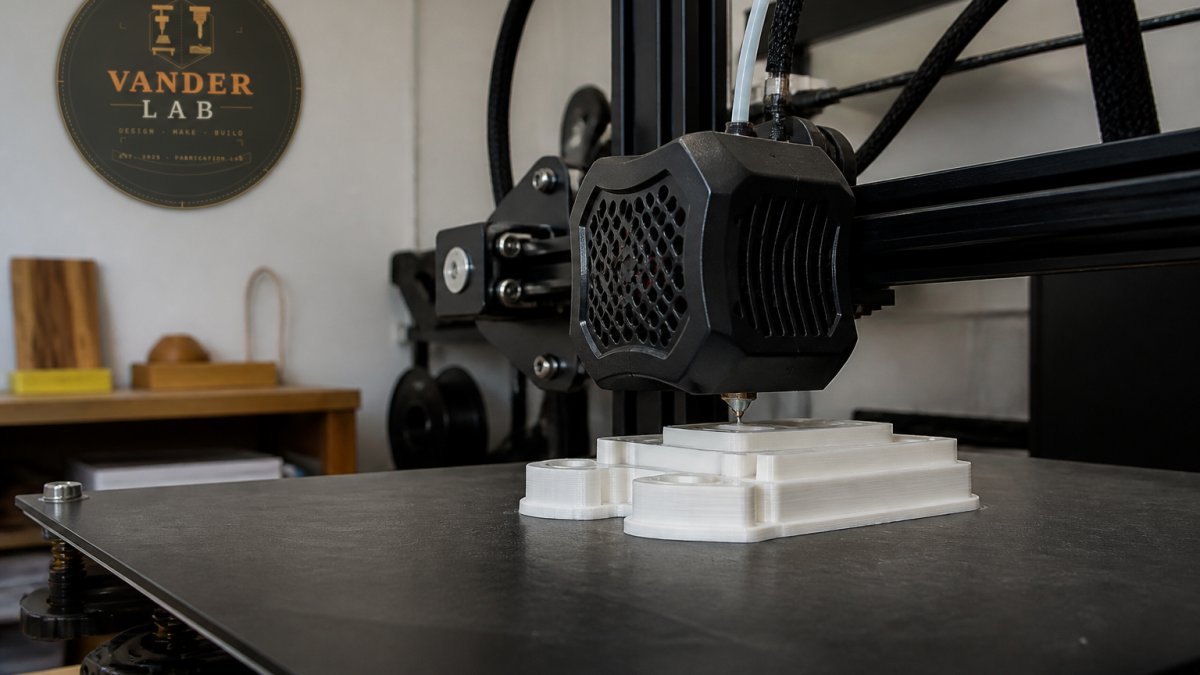
For small batches, prototypes, and custom orders, 3D printing offers flexibility that traditional manufacturing can't match. You're not locked into a design once production starts.
Injection Molding: Subtractive and Tooling-Based Production
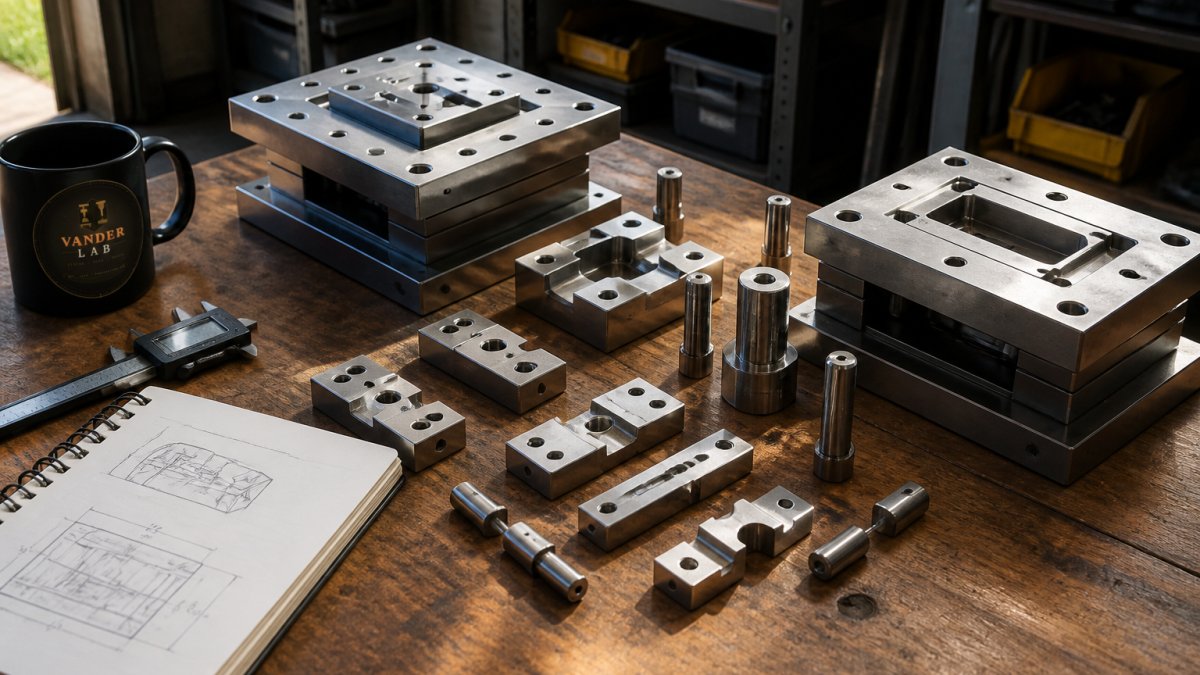
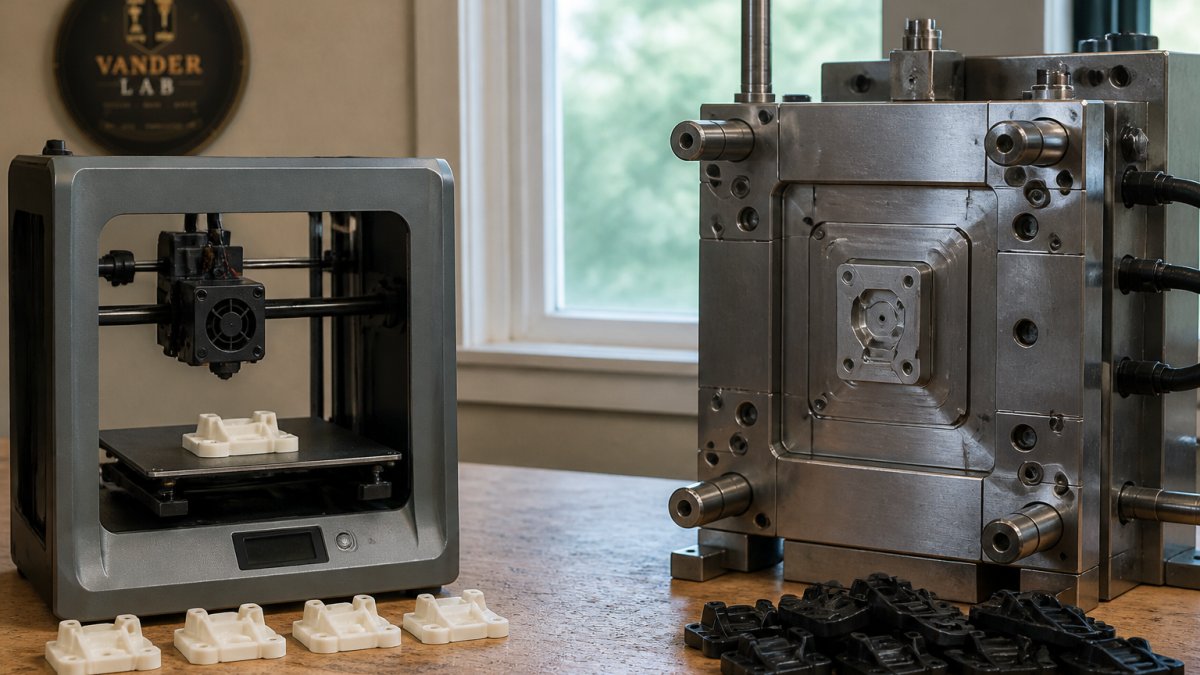
Injection molding forces melted thermoplastic into a custom metal mold under pressure. Once the mold cools, the part ejects and the cycle repeats. The machined mold is expensive upfront, but each part that follows costs very little to produce.
The mold is the barrier to entry: a custom injection mold can take weeks to machine and costs far more than a 3D printing setup. But once it exists, you can produce hundreds or thousands of identical parts at a fraction of the per-unit cost of 3D printing.
Injection molding can deliver a professional result for consumer products where appearance and durability matter.
3D Printing vs Injection Molding Cost: Tooling, Per-Part, and Break-Even
The cost comparison hinges on production volume. The useful version of that relationship is a formula you can run with your own numbers, not a single threshold pulled from someone else's part.
With 3D printing, you have almost no upfront cost. You buy a printer or access a printing service, prepare your file, and start producing.
Injection molding flips this model. According to Fictiv's analysis of injection molding economics, 3D printing is less expensive at lower part volumes because it avoids the cost of a machined metal mold, while injection molding can become more economical above a few hundred parts.
A Break-Even You Can Actually Run
Instead of memorizing a volume threshold, calculate the crossover point for your own part: total cost equals tooling plus per-part cost times quantity for each method. Set the two equal and solve for quantity.
- 3D printing total cost = (per-part print cost) × (quantity)
- Injection molding total cost = (mold and tooling cost) + (per-part molded cost) × (quantity)
- Break-even quantity = tooling cost ÷ (print per-part cost − molded per-part cost)
That last line is the whole decision in one equation. Below the break-even quantity, 3D printing costs less; above it, molding wins. The break-even moves whenever an input moves, which is why a single published threshold is misleading.
What Moves the Crossover Point
- Tooling cost. A simpler mold with looser tolerances costs less to cut and lowers the break-even quantity. A complex mold with slides or tight tolerances raises it.
- The per-part cost gap. The wider the difference between your printed part cost and your molded part cost, the faster molding pays back its tooling.
- Part size and material. Large parts and engineering-grade thermoplastics raise both print cost and mold cost, sometimes in different proportions.
- Revisions. Every design change after tooling means either cutting a new mold or modifying the existing one. Those costs belong on the molding side of the equation, and they push the break-even higher.
- Finishing and inspection. Printed parts often need more hand-finishing to match a molded surface, and that labor belongs in the print per-part cost.
Total Cost of Ownership, Not Just Tooling
Tooling plus per-part price is the headline, not the whole bill. A realistic comparison also weighs setup and fixture costs, finishing and inspection labor, shipping and packaging, inventory carrying cost, machine utilization, and unsold stock. Molding usually forces a minimum order quantity, so you may pay for units that sit in a bin for months; 3D printing produces on demand, keeping cash free at a higher per-unit cost. Compare total cost for the units you will actually sell.
Many small businesses underestimate future demand and commit to injection molding too early. If you're uncertain about volume, start with 3D printing. Switching later is cheaper than tooling for a run you never need.
For small businesses, this means asking: How many units do I actually need? If it's between 100 and 500, run the equation above with your own numbers rather than guessing.
3D Printing vs Injection Molding Production Volume: Finding Your Sweet Spot
Production volume determines which method makes sense. For a small business, the volume question is really a cash-flow and inventory-risk question wearing a production hat.
3D printing scales poorly with volume. Per-part cost stays constant, but total production time climbs linearly, printing 1,000 parts takes roughly 10 times longer than printing 100.
Injection molding scales beautifully with volume. After the mold is paid for, each additional part costs almost nothing, and cycle time is measured in seconds to minutes, not hours.
According to Formlabs' analysis of 1,000-part production runs, 3D printing costs 85% less in the specific scenario they modeled, though that comparison is specific to their part and may not predict costs for other designs.
The Small-Business Constraint Competitors Skip
Most volume guides stop at the scaling curve. What actually decides the question for a small business is what volume does to cash and inventory.
- Tooling capital is spent before a single sale. A mold is paid upfront, which ties up money that could otherwise fund marketing, materials, or a second product line. 3D printing spreads that spend across orders as they come in.
- Minimum order quantities create unsold stock. Molding economics usually push you toward a larger run than your current demand supports. Every unit that doesn't sell is cash sitting on a shelf, and it may become obsolete if the design changes.
- Demand uncertainty favors on-demand production. If you're still learning whether a product sells, producing on demand with 3D printing keeps you from betting tooling dollars on a forecast you haven't validated.
- Inventory carrying cost is real. Storage, insurance, shrinkage, and the opportunity cost of tied-up capital all count against a large molded run, even when the per-part price looks attractive.
Finding Your Sweet Spot
You need your actual volume forecast and an honest read on whether demand will grow.
A practical way to frame it: if you can sell through a molded run within a reasonable window and the design is stable, molding's low per-part cost wins. If demand is lumpy, seasonal, or still being proven, 3D printing's on-demand model protects your cash and keeps you flexible. The sweet spot isn't a fixed number of units, it's the point where your confirmed demand comfortably covers the tooling investment and the inventory you'll carry.
Before committing to a molded run, map your last few months of actual sales against your forecast. If the two don't line up, the volume case for molding isn't there yet, no matter what the per-part price says.
3D Printing vs Injection Molding Lead Time: Speed to First Part
For businesses that need parts fast, lead time is everything. 3D printing and injection molding operate on completely different timescales.
3D printing delivers parts in days, sometimes hours. Once your file is ready, printing starts immediately, no waiting for mold design, tooling, or setup. For prototypes, urgent orders, and design iterations, that speed is invaluable.
Injection molding requires weeks to months for the mold alone. Mold design, CNC machining, testing, and refinement take time.
For small businesses that can't wait, 3D printing is the practical choice. For businesses that can plan ahead and need volume, injection molding's longer lead time is a trade-off worth making.
Design Flexibility, Material Properties, and Part Quality
The two methods produce different results beyond cost and speed.
3D printing offers design freedom: complex geometries, internal channels, and organic shapes that would be impossible or prohibitively expensive to mold.
Injection molding produces superior surface finish and dimensional accuracy.
According to Uptive Manufacturing's comparison of injection molding and 3D printing, injection molding's advantages include superior surface finish and specific mechanical properties, plus potential cost-effectiveness at high production volumes.
Material selection also differs. 3D printing offers a growing range of materials, PLA, PETG, ABS, TPU, resin, nylon, but injection molding supports a wider catalog of engineered thermoplastics with proven performance in production environments.
When to Switch from 3D Printing to Injection Molding
The transition from 3D printing to injection molding isn't a sudden switch. Most small businesses move gradually, driven by demand and economics.
Start with 3D printing when you're validating a product or fulfilling custom orders. The low upfront cost and design flexibility let you test ideas without risk. As demand grows and you understand your market, the case for molding strengthens.
The trigger to switch usually hits when one of these conditions is true:
- Your volume forecast exceeds 300-500 units per year
- You're making the same part repeatedly and 3D printing lead times become a bottleneck
- Per-part costs from 3D printing exceed what molding would cost
- You need material properties or surface finish that 3D printing can't deliver
Before switching, validate that demand is stable. A temporary spike doesn't justify tooling. You're betting on sustained volume, so make sure the forecast is realistic.
A Hybrid Approach: Combining Both Methods for Smarter Production
Start with 3D printing to prototype, test, and refine. Use it for custom orders and small batches. As volume grows and your design stabilizes, transition production to injection molding for the high-volume runs. Use 3D printing for design changes, new SKUs, and low-volume variants.
This hybrid approach gives you speed and flexibility early, then cost efficiency at scale. You're not locked into one technology. You're using each where it excels.
Deciding between 3D printing and injection molding requires honest answers about production volume, design flexibility, and timeline. If you're exploring 3D printing for prototypes or custom parts, VanderLab's eBay Shop offers ready-made printed parts and components, or you can get a custom quote to discuss your specific project and find the right approach for your business.
Frequently Asked Questions
When does injection molding become more cost-effective than 3D printing?
Injection molding becomes cost-effective when production volume justifies the upfront tooling investment. For low-volume runs (under 100-500 parts), 3D printing typically costs less because it avoids expensive mold creation. As volume grows, the per-part cost of injection molding drops significantly, eventually offsetting the initial tooling expense. The exact break-even point depends on part complexity, material, and your specific production timeline.
Can 3D-printed parts be used for end products?
Yes, 3D-printed parts work well for end products, especially when durability and precision meet your application needs. Materials like PETG, ABS, and TPU offer strength comparable to injection-molded plastics for many uses. However, 3D printing typically produces a rougher surface finish and may have slightly lower dimensional accuracy than injection molding. For consumer-facing products requiring a polished finish or exact tolerances, post-processing or injection molding may be preferable.
How many parts should a small business order before choosing injection molding?
Most small businesses consider switching to injection molding when planning runs of 500-1,000 parts or more. The decision depends on your timeline, budget, and how critical per-part cost savings are. If you need parts quickly and can absorb higher per-unit costs, 3D printing remains practical even at higher volumes. If you're willing to wait for tooling and want to minimize per-part expense on large runs, injection molding becomes attractive sooner.
What is the most profitable thing to 3D print and sell?
Custom, low-volume products with high perceived value tend to be most profitable: personalized gifts, specialized organizational tools, replacement parts for niche markets, and bespoke components for local businesses. These items benefit from 3D printing's design flexibility and quick turnaround without requiring large production runs. Success depends on targeting customers who value customization and craftsmanship over mass-market pricing.