 comparison
Xometry vs Protolabs: CNC Machining Comparison
Table of Contents
- Xometry vs Protolabs: Overview
- How the Marketplace Model Differs from In-House Manufacturing
- Xometry vs Protolabs CNC Machining Capabilities
- Xometry Rapid Prototyping and Design Feedback
- Xometry vs Protolabs Pricing and Quote Comparison
- Xometry Alternatives for CNC Machining
- Which Service Fits Your Project
- Frequently Asked Questions
Last Updated: October 12, 2026
Xometry vs Protolabs: Overview
When you need custom-machined parts or rapid prototypes, two names dominate: Xometry and Protolabs. Both connect your designs to fabrication partners, but they work very differently, and which one fits depends on what you're building.
At VanderLab, we understand the nuances of both. The real difference isn't which is "better", it's which matches how you work.
This comparison covers the core trade-offs, sourcing, pricing, delivery speed, and project fit, plus alternatives if neither feels right.
How the Marketplace Model Differs from In-House Manufacturing
Xometry and Protolabs are often described as if they work the same way. They don't.
The marketplace model
Xometry operates as a distributed network. You upload a design, the platform routes it to a supplier, and that shop manufactures the part.
The advantages are real: broad capacity, specialty processes, and price competition. So are the trade-offs.
The owned-capacity model
Protolabs owns a meaningful share of its manufacturing capacity, particularly for rapid prototyping and low-volume production, so it controls scheduling, quality, and lead time more directly.
The advantage is predictability.
Supplier accountability: who owns a bad part
Most comparisons skip this. On a marketplace, the platform is customer-facing, but the supplier made the part. Ask upfront:
- Who inspects the part before it ships?
- What documentation travels with it?
- If it fails incoming inspection at your facility, who pays for the rework or reorder?
- How is a nonconformance logged and resolved?
- Can you request the same supplier for a repeat order?
On an owned-capacity model, those answers are simpler, one organization in the chain. On a marketplace, they depend on supplier agreements worth reading before you place a production order.
Confidentiality and IP protection
Every CAD file contains your design intent, and on a marketplace it may be shared with multiple suppliers during bidding. Before uploading anything sensitive:
- Read the platform's data-handling and confidentiality terms.
- Ask whether your file is shared with all bidders or only the selected supplier.
- Ask whether suppliers are under nondisclosure agreements.
- Ask how long your files are retained and whether you can request deletion.
- For defense, medical, or otherwise regulated work, confirm whether the platform and its suppliers meet the relevant requirements before you send a file.
On an owned-capacity model, the file stays inside one organization, which simplifies the question but doesn't eliminate it.
Traceability and repeatability
If you need material certifications, lot traceability, or documented inspection, ask how each model handles them.
Where a local shop fits
An in-house shop like ours sits at the other end of the spectrum. We offer direct accountability, a real conversation about tolerances, and no platform-to-supplier handoff.
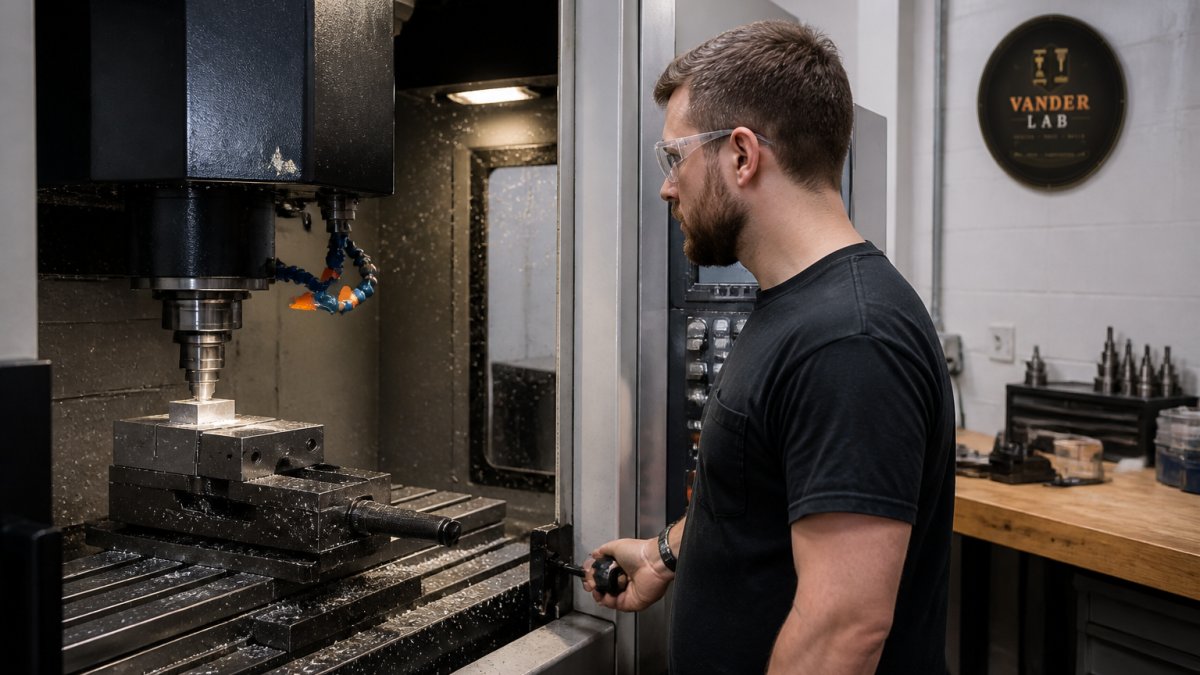
For most one-off projects, the marketplace model is fast and cost-effective.
Xometry vs Protolabs CNC Machining Capabilities
Both platforms handle CNC machining, but differently. Xometry positions itself as the flexible option: upload a CAD file, get manufacturability feedback within minutes, and tap a network of hundreds of machine shops nationwide, so capacity is rarely the bottleneck.
Protolabs owns some of its own manufacturing capacity, giving it tighter control over quality and lead time, with rapid-prototyping equipment tuned for speed. For simple parts with standard tolerances, Protolabs often delivers faster because it isn't waiting on a third-party shop's schedule.
Where Xometry wins: complex parts, exotic materials, and tight tolerances. Its network includes specialty shops that handle aerospace-grade aluminum, titanium, or custom alloys, so designs that push standard machines get more options.
Where Protolabs wins: straightforward parts, quick turnarounds, and consistency. For a simple bracket or enclosure with standard tolerances, owned capacity means faster, more predictable delivery.
For CNC work, the real question is your part's complexity. Simple geometry and standard materials? Protolabs. Complex design, exotic materials, or tight tolerances? Xometry.
Xometry Rapid Prototyping and Design Feedback
Xometry's biggest strength is design feedback. Their system uses AI to scan your CAD file and flag manufacturability issues in real time. You see suggestions before you submit a quote. That saves rounds of back-and-forth with a shop engineer.
The feedback covers the essentials: wall thickness, hole size, draft angles, and material selection. A wall too thin to machine or a tolerance tighter than the process can deliver gets flagged immediately, speeding up the entire cycle.
Protolabs also offers design feedback, but less automated: a human engineer reviews your upload. That's more thorough but slower, so for fast prototype iteration, Xometry's instant feedback loop wins.
For rapid prototyping across multiple iterations, Xometry's speed matters: refine your design, get instant feedback, and submit a new quote within hours. Protolabs' human review is more careful but suits rapid iteration less well.
Xometry vs Protolabs Pricing and Quote Comparison
Pricing is where this comparison gets real, and where most write-ups stop short. Neither platform publishes a fixed rate card; both require a design upload and quote request. The difference is how each quote is built and what it includes.
How each quote is constructed
Xometry's pricing is shaped by its supplier network. Multiple shops can bid, and the quote reflects the winning bid plus platform margin.
Protolabs builds quotes around its own capacity and standardized process routing. Because the work runs on equipment it controls, quotes tend to be more consistent submission to submission, the trade-off for less downward pressure from competing bids.
A like-for-like comparison methodology
Headline quotes aren't comparable unless you control the inputs. To compare fairly, hold all of these constant across both platforms:
- The same CAD file, same revision, same units
- The same material and temper or alloy specification
- The same surface finish callouts
- The same tolerance block on the drawing
- The same quantity, and the same quantity breaks if you are pricing a range
- The same inspection requirements (standard vs. documented)
- The same shipping speed and destination
- The same requested lead time
Change any one and you're no longer comparing platforms, you're comparing two different jobs.
The cost drivers that move the number
A few variables drive most quotes:
- Geometry complexity. More setups, fixturing, and tool changes. A one-setup part prices very differently from one needing four.
- Tolerance tightness. Tight tolerances slow the machine, increase inspection time, and raise scrap risk.
- Material. Commodity aluminum and standard plastics at one end; titanium, engineering resins, and specialty alloys at the other.
- Quantity. Per-unit cost falls as volume rises, but the curve flattens at different points by process.
- Finishing and post-processing. Anodizing, bead blasting, heat treating, and assembly each add a line item and a scheduling step.
- Inspection and documentation. First-article inspection, material certs, and dimensional reports aren't free, and not every quote includes them by default.
- Lead time. Expedited turnaround is the most expensive variable in most quotes.
Total cost of ownership, not headline price
The quoted number is rarely what you pay. Build a total-cost view including:
- Shipping and any expedite charges
- Finishing and post-processing
- Inspection and documentation
- Design revisions and re-quotes
- Tooling or fixturing if the job needs it
- The cost of a bad part: rework, reorder, and the schedule slip that follows
A lower headline quote that arrives late or out of spec isn't cheaper. A higher quote that lands on time and passes inspection often is.
Repeat orders and price stability
This is where the two models diverge most. On a marketplace, a repeat order may route to a different supplier than the first run, changing price, lead time, and even small details of how the part is made.
How to actually run the comparison
- Finalize your CAD file and drawing. Freeze the revision.
- Write down material, finish, tolerance, quantity, inspection, and lead-time requirements.
- Submit the identical package to both platforms.
- Record the quote, quoted lead time, and what is and isn't included.
- Ask each platform what happens if the part fails inspection.
- Re-quote at production quantity, not just prototype quantity.
The numbers tell you which platform fits your budget. The fine print tells you which fits your project.
For local work where you want the quote and the maker in the same conversation, a shop like ours prices the job directly, with finishing and hand-work considered in the quote.
Xometry Alternatives for CNC Machining
If neither Xometry nor Protolabs feels right, several alternatives deserve consideration. Fictiv runs a similar marketplace model focused on injection molding and CNC, with design feedback comparable to Xometry's and a strong West Coast supplier network. Unionfab specializes in rapid prototyping with a tighter shop network, which can mean faster turnarounds for simple parts. RapidDirect focuses on cost-competitive manufacturing for production runs, a good fit when scaling beyond prototypes.
For local, hands-on work, in-house shops like VanderLab offer what marketplaces can't: direct accountability and custom collaboration. In the Mebane area, working with a local shop can offer a different value proposition, you trade marketplace price competition for the relationship and control of a dedicated shop.
Each alternative has a fit: Fictiv for injection molding, Unionfab for tight-tolerance prototypes, RapidDirect at scale, and a local shop when you need custom guidance or have unusual requirements.
Which Service Fits Your Project
The decision comes down to three questions: How fast do you need it? How complex is your design? How many iterations are you planning?
Need a prototype in under a week with standard tolerances? Both work. Protolabs is faster for simple geometry; Xometry is faster when you need design feedback and iteration.
If your part is complex, tight tolerances, unusual geometry, exotic materials, Xometry's distributed network usually wins. Their supplier base includes specialty shops that can handle edge cases Protolabs' standardized capacity might reject.
Scaling from prototype to production? Pricing matters more. Get quotes from both and run a like-for-like comparison on your actual design. The numbers may surprise you, sometimes Protolabs is cheaper at scale, sometimes Xometry. It depends on your part.
In the Mebane area and want a different approach entirely? Consider working directly with a local fabrication lab. You get faster communication, direct accountability, and real-time collaboration on design changes. We handle custom CNC routing, 3D printing, and laser engraving for projects from one-off prototypes to small production runs, and for local work, that personal touch often beats the marketplace model.
The best choice is the one that matches your workflow, timeline, and tolerance for variability.
Choosing between Xometry and Protolabs depends on your project's complexity and timeline. But if you want direct collaboration with someone who builds precision parts right here in Mebane, we can help. Get a custom quote and see how hands-on fabrication compares to the marketplace approach. You can also browse our work and capabilities on our eBay Shop to see examples of precision pieces we've built for customers.
Frequently Asked Questions
What is the main difference between Xometry and Protolabs?
Xometry operates as a manufacturing marketplace connecting customers with a network of suppliers, while Protolabs combines owned factory capacity with a supplier network. This means Protolabs has more direct control over quality and turnaround times for certain processes, whereas Xometry's model offers access to a broader range of capabilities and often faster quotes through its digital platform. The choice depends on whether you prioritize speed, consistency, or access to specialized manufacturing processes.
Is Xometry or Protolabs better for CNC machining?
Both excel at CNC machining, but they serve different needs. Protolabs owns CNC capacity and typically delivers faster turnaround for standard jobs, making it ideal for tight deadlines. Xometry's supplier network offers more flexibility on complex geometries, material choices, and custom specifications. For low-volume production runs or parts with unusual requirements, Xometry often provides more options. For high-speed, repeatable jobs, Protolabs' owned capacity has an advantage.
How do Xometry and Protolabs handle design feedback and manufacturability?
Both platforms offer design-for-manufacturability (DFM) feedback before you commit to production. Protolabs provides this through its owned engineering team, ensuring consistency. Xometry's system uses AI to scan your CAD file and flag manufacturability issues in real time, speeding up the entire cycle.
What alternatives to Xometry and Protolabs exist for CNC machining?
Several on-demand manufacturing services compete in this space, including Fictiv, Unionfab, and RapidDirect. Each operates on a similar digital-quotation model but with different supplier networks and specialties. Fictiv runs a similar marketplace model focused on injection molding and CNC, with design feedback comparable to Xometry's. Unionfab specializes in rapid prototyping with a tighter shop network. RapidDirect focuses on cost-competitive manufacturing for production runs. For local, handcrafted precision work, smaller fabrication shops in your area may offer personalized service and tighter tolerances on specialized projects.