 ultimate-guide
What Are the Biggest Industrial 3D Printing Trends for 2026?
Last Updated: October 25, 2026
Quick Summary
Industrial 3D printing trends for 2026 center on the shift from experimental prototyping to reliable production-grade manufacturing. Industrial 3D printers are projected to hold 51.66% of the 3D printing market in 2026, with growth driven by aerospace, medical devices, and consumer goods applications that demand precision, repeatability, and traceability at scale.
- The global 3D printing market is projected to grow from USD 16.43 billion in 2026 to USD 31.77 billion by 2032 at an 11.6% compound annual growth rate.
- Hardware segment is projected to account for 46.82% of the 3D printing market in 2026, reflecting investment in production-level machines.
- Metal additive manufacturing leads growth, with titanium, aluminum, and nickel-based superalloys enabling aerospace, medical, and high-temperature applications.
- AI and automation are optimizing print parameters in real time and reducing setup and post-processing labor in industrial workflows.
- Production readiness requires four aligned elements: repeatability and process validation, traceability, inspection and testing, and standards and certification.
Table of Contents
- From Prototyping to Production: The Shift Reshaping Industrial 3D Printing
- Industrial 3D Printing Applications Driving Growth in 2026
- 3D Printing Materials for Manufacturing: What's Gaining Ground
- AI and Automation Reshaping Industrial 3D Printing Workflows
- Industrial 3D Printing Quality Control and Production Readiness
- Additive Manufacturing Design Best Practices for Production Parts
- Getting Started With Industrial 3D Printing for Your Shop
- Frequently Asked Questions
Industrial 3D printing is reshaping manufacturing in 2026. The global 3D printing market is projected to grow from USD 16.43 billion in 2026 to USD 31.77 billion by 2032, at an 11.6% compound annual growth rate, according to MarketsandMarkets global market forecast. But the numbers tell only part of the story. What's actually changing is how manufacturers think about the technology itself. The shift from experimental prototyping to reliable production is now the defining trend. Here, we break down the biggest industrial 3D printing trends expected for 2026 and what they mean for your operation.
From Prototyping to Production: The Shift Reshaping Industrial 3D Printing
The industrial 3D printing industry has spent years proving the technology works. Industrial 3D printers are projected to hold 51.66% of the 3D printing market in 2026, according to Fortune Business Insights market-share analysis, and that dominance reflects a fundamental shift in how the technology is being deployed.
What's different now is the focus on repeatability and reliability. A printer can produce one perfect part. The real test is producing the hundredth part identically. This is where most emerging industrial 3D printing trends converge.
The hardware segment is projected to account for 46.82% of the 3D printing market in 2026, according to Fortune Business Insights hardware segment analysis. This reflects growing investment in machines capable of production-level output, not experimental prototyping.
Industrial 3D Printing Applications Driving Growth in 2026
The applications pushing industrial 3D printing forward in 2026 share one characteristic: they benefit from design freedom that conventional manufacturing cannot match. Aerospace components with internal cooling channels, medical implants tailored to patient anatomy, and consumer goods with complex geometries are the leading use cases.
Aerospace and defense remain the largest sectors. These industries value the ability to reduce part weight while maintaining structural integrity, and additive manufacturing delivers both. Medical device manufacturers are using 3D printing for customized implants and surgical guides, where one-off production runs justify the technology's precision and speed.
The common thread is customization. Industrial 3D printing applications excel when the value of a custom part exceeds the cost of the fabrication process. Construction and infrastructure are emerging sectors, with concrete printing and metal additive manufacturing creating new possibilities for on-site fabrication and reduced material waste.
3D Printing Materials for Manufacturing: What's Gaining Ground
Material innovation is accelerating across both metal and polymer categories. The industrial 3D printing market is expanding not just in volume but in material capability. Advanced materials, titanium alloys, nickel-based superalloys, and high-performance polymers, are enabling applications that were impossible five years ago.
Metal additive manufacturing is leading growth. Titanium and aluminum alloys dominate aerospace and medical applications, where weight savings and strength-to-density ratios are critical. Nickel-based superalloys are opening doors in high-temperature applications like turbine blades and engine components.
Polymer 3D printing materials are expanding beyond prototyping resins. High-performance polymers like PEEK and carbon-fiber-reinforced nylons are entering production workflows. You'll want to explore best 3D printing materials for functional parts in 2026 to understand which materials suit your production needs.
Industrial 3D printing materials are expanding rapidly across metal and polymer categories, each suited to different production demands.
| Material | Best For | Key Advantage |
|---|---|---|
| Titanium and aluminum alloys | Aerospace and medical | Weight savings and strength-to-density ratio |
| Nickel-based superalloys | High-temperature applications | Enable turbine blades and engine components |
| PEEK and carbon-fiber-reinforced nylons | Functional polymer parts | Bridge speed of polymer printing with strength |
| Advanced metal alloys | Production-grade manufacturing | Enable applications impossible five years ago |
AI and Automation Reshaping Industrial 3D Printing Workflows
Digital workflow integration is a key direction for additive manufacturing in 2026. AI and automation are moving beyond experimental features into core production systems. Machine learning algorithms now optimize print parameters in real time, adjusting for material variability and environmental factors that would normally require manual intervention.
Automation is reducing the human labor required for setup, monitoring, and post-processing. Industrial 3D printing workflows that once required constant operator attention can now run with minimal oversight. AI-powered quality control systems inspect parts during and after printing, catching defects before they reach downstream processes.
The real advantage is speed. Automated workflows compress the time from design file to finished part from days to hours. This matters for high-mix, low-volume production, where setup time is typically the largest cost driver.
Industrial 3D Printing Quality Control and Production Readiness
Production readiness is increasingly judged by repeatability and reliability, not only by what a printer can produce. This is the critical shift defining industrial 3D printing in 2026.
Most trend coverage stops at "quality is getting better." The practical question is narrower: what has to be true before a printed part can go into a regulated product?
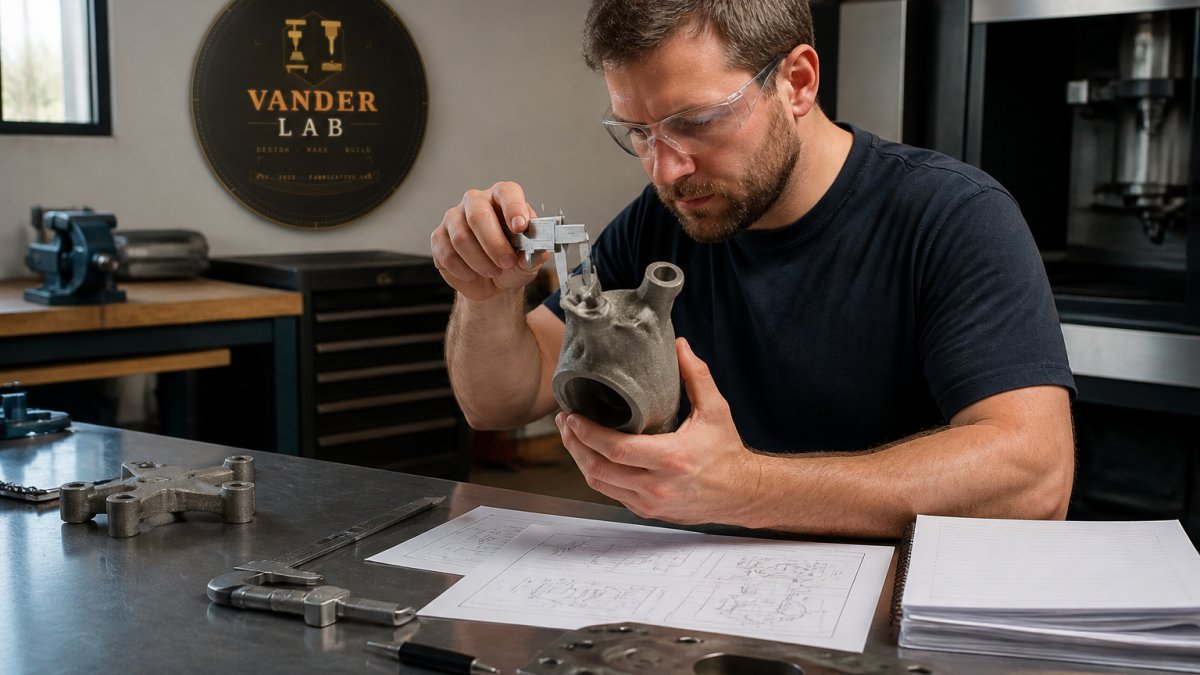
Repeatability and process validation. A production process has to demonstrate that it produces the same result across machines, operators, material lots, and build runs.
Traceability. Regulated buyers need to know which machine, which material lot, which operator, and which build a given part came from.
Inspection and testing. Printed parts often cannot be inspected the same way as machined parts.
A useful way to think about readiness is to separate what a process can do from what a process can prove. A shop that can print a complex metal part has a capability. A shop that can print that part a hundred times, document each one, inspect the critical features, and hand a buyer a traceable record has a production asset. The second is what 2026 buyers are actually paying for, and it is the part of the trend that gets the least attention in most forecasts.
For deeper guidance on troubleshooting and quality assurance, 3D print failed? What to do next (2026 guide) covers practical steps for diagnosing and preventing common production issues.
Additive Manufacturing Design Best Practices for Production Parts
Designing for additive manufacturing requires fundamentally different thinking than conventional manufacturing. The design freedom that makes 3D printing powerful also requires disciplined decision-making. Parts designed for subtractive or injection-molded production often fail when translated to additive processes.
Key principles include wall thickness consistency, support structure minimization, and stress concentration awareness. Design tools that simulate print behavior and material flow are becoming standard. CAD software now includes additive manufacturing-specific features that flag design issues before the file reaches the printer.
The shift from prototyping to production design means moving beyond "can we print this?" to "should we print this?" A part that's technically printable may not be economically viable or functionally superior to conventional alternatives. Designers working with industrial 3D printing applications need to evaluate trade-offs between design freedom, material cost, print time, and post-processing requirements. How to design machine-ready parts: A step-by-step guide walks through translating design principles into production-ready files.
Getting Started With Industrial 3D Printing for Your Shop
Starting with industrial 3D printing doesn't require a massive capital investment or a complete manufacturing overhaul. The most successful implementations start with a specific, high-value application.
Build the full cost picture, not just the machine price. The purchase price of an industrial printer is the smallest part of the decision for most shops. A realistic total cost of ownership comparison against conventional manufacturing has to include:
- Equipment and installation. The printer itself, plus facility upgrades for power, ventilation, and material storage.
- Materials. Feedstock costs per part, plus the scrap and waste that come with failed builds and support structures.
- Labor. Setup, monitoring, depowdering, support removal, and post-processing. Post-processing is frequently the largest hidden labor cost in metal additive, and it is easy to underestimate.
- Post-processing equipment. Furnaces, stress relief, machining for critical surfaces, and surface finishing.
- Qualification and inspection. CT scanning, witness coupons, and engineering time for process validation.
- Maintenance and consumables. Lenses, nozzles, filters, and calibration.
The comparison that matters is cost per qualified part at your actual volume, not cost per part in a demo.
Use a simple decision framework by application. Rather than asking "metal or polymer?" in the abstract, match the process to the part:
- Part size and geometry. Large parts and complex internal channels favor additive; simple prismatic parts usually favor conventional machining.
- Tolerances. Tight tolerances on critical surfaces often mean printing near-net and machining to finish, which is a hybrid approach rather than a pure additive one.
- Volume. High-mix, low-volume work is where additive shines. As volume climbs, tooling-based processes usually win on unit cost.
- Material. Titanium and nickel-based superalloys are where metal additive earns its keep; commodity polymers rarely justify industrial equipment on cost alone.
- Regulatory burden. If the part goes into a regulated product, add qualification time to the timeline before you commit.
Start small and measure. The pattern that works is to pick one part, run it through both the additive and conventional paths, and compare lead time, cost per qualified part, and yield. If the additive path wins on those three, expand.
Small-batch manufacturing for startups often begins with polymer 3D printing, which has lower equipment costs and faster iteration cycles. Metal additive manufacturing requires larger production volumes to justify equipment and material costs, and the qualification burden is heavier.
Partner with experienced fabricators who understand both the technology and your industry's qualification requirements. If you're evaluating whether industrial 3D printing makes sense for your operation, request a custom quote to discuss your specific application and get guidance on the right approach, whether that's 3D printing, CNC machining, or a hybrid combination. You can also explore available capabilities and inventory through our eBay Shop. Small batch manufacturing for startups: A guide provides a practical framework for evaluating whether and how to implement additive manufacturing in your operation.
Frequently Asked Questions
What are the biggest industrial 3D printing trends for 2026?
Industrial 3D printing trends for 2026 center on moving from experimental prototyping to production-ready parts, with repeatability and reliability becoming the measure of success. The industry is also integrating AI and automation into digital workflows, expanding material options for manufacturing, and adopting 3D printing for high-mix, low-volume production runs. Metal additive manufacturing is projected to grow from $20.8 billion in 2026 to $73.8 billion by 2035, at a 15.1% annual growth rate, signaling sustained investment in production-scale applications.
How is industrial 3D printing changing manufacturing in 2026?
Manufacturers are moving beyond one-off prototypes to using 3D printing for functional end-use parts, particularly in aerospace, medical devices, and defense. This shift demands tighter quality control, standardized processes, and digital workflow integration. Repeatability and production readiness now matter as much as design capability.
Can 3D printing be used for end-use production parts?
Yes. Industrial 3D printing is increasingly used for production parts, not just prototypes. Metal additive manufacturing, in particular, is gaining adoption for aerospace components, medical implants, and specialized industrial parts where design freedom and customization justify the technology. Success depends on production qualification, material performance validation, and quality assurance processes that meet industry standards. Repeatability and reliability are now the standards by which production-ready 3D printing is judged.
What challenges do manufacturers face when adopting industrial 3D printing?
Key challenges include achieving production-scale repeatability, managing material costs, ensuring quality assurance and regulatory compliance, and integrating 3D printing into existing factory workflows. Worker safety is also a consideration, as NIOSH notes that rapid expansion of additive manufacturing can expose workers to potential health hazards. Many manufacturers are still in the early stages of moving from prototyping to production, meaning adoption and implementation remain works in progress despite the technology's maturity.