 ultimate-guide
Best 3D Printing Materials for Functional Parts in 2026
Table of Contents
- How to Choose the Best 3D Printing Materials for Functional Parts
- Material Comparison Table: Strength, Heat, and Printability
- PETG vs ABS for Functional Parts: Which One Fits Your Application
- Nylon, Polycarbonate, and Carbon Fiber: High-Performance Options
- Material Aging and Failure Modes: What Competitors Skip
- Best Practices for Printing Functional 3D Parts
- Frequently Asked Questions
Last Updated: September 19, 2026
How to Choose the Best 3D Printing Materials for Functional Parts
Choosing the best 3D printing materials for functional parts comes down to four properties: tensile strength, heat deflection temperature, impact resistance, and layer adhesion. Get those right for your application and the part survives. Get them wrong and it fails in the field.
The Four Properties That Decide Every Functional Part
Tensile strength is how much pull a part withstands before it breaks. Heat deflection temperature is the point where a loaded part starts to sag. Impact resistance measures how it handles sudden shock rather than slow force. Layer adhesion determines whether the part fails along its layer lines, which is where most printed parts break.
Material Comparison Table: Strength, Heat, and Printability
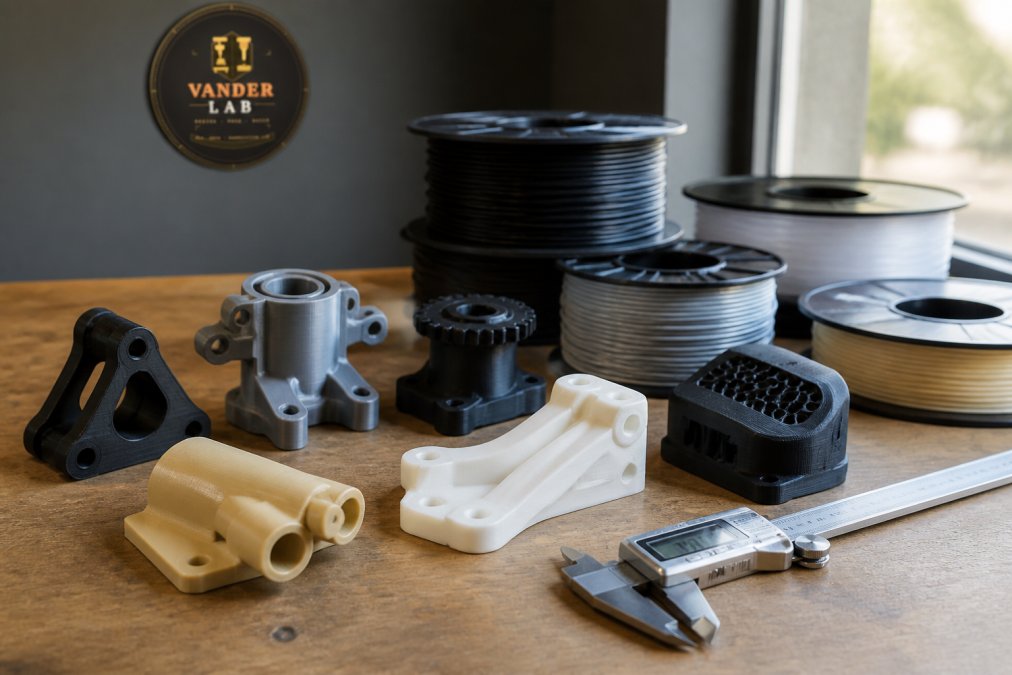
The table below summarizes how the main filament families compare for functional work. Treat it as a starting filter, not a final answer.
| Material | Strength | Heat Resistance | Print Difficulty | Best For |
|---|---|---|---|---|
| PLA | High stiffness | Low | Easy | Prototypes, non-load parts |
| PETG | Good, tough | Moderate | Easy | General functional parts |
| ABS | Good | High | Hard (warps) | Heat-exposed parts |
| ASA | Good | High | Hard | Outdoor parts |
| Nylon (PA12) | Very high | Moderate | Hard | Gears, hinges, snap fits |
| Polycarbonate | Very high | High | Very hard | Heavy-duty load parts |
| Carbon fiber blend | Very stiff | Varies | Moderate | Brackets, frames |
| TPU | Low stiffness | Low | Moderate | Gaskets, bumpers |
PETG vs ABS for Functional Parts: Which One Fits Your Application
PETG wins for most indoor functional parts. ABS wins when heat is the deciding factor. That's the short version, and it's where most comparisons stop. The longer version is about how each material behaves once the part is in service.
Where each material actually breaks down
PETG fails in a ductile way. Under overload it stretches, whitens at the stress point, and yields before it tears. That's a forgiving failure mode for a bracket or a mount, because you usually see the deformation before the part lets go. Its glass transition temperature sits low enough that a part under continuous load in a hot car or against a sunny window can creep, slowly sagging out of shape rather than snapping.
The printability trade-off
This is the part the shopping guides skip. ABS needs a heated chamber or a well-sealed enclosure to keep large flat parts from curling, and it releases fumes during printing that call for ventilation. PETG prints on an open printer, tolerates a wider bed-temperature window, and warps far less, which means a first-time functional print in PETG is more likely to come out structurally sound than the same part in ABS.
A quick decision path
- Indoor bracket, mount, or enclosure that sees normal room temperatures: PETG. Better layer adhesion, easier print, ductile failure you can see coming.
- Part near a heat source, inside a vehicle, or in direct summer sun: ABS or ASA. Higher glass transition temperature holds shape where PETG would creep.
- Outdoor part exposed to sunlight for months: ASA over ABS. Same heat resistance, formulated to resist UV degradation.
- Part that must survive a sharp impact without shattering: lean toward PETG or nylon rather than ABS, which is more brittle under shock.
A practical pattern many makers settle into: prototype the geometry in PLA, print the working part in PETG, and only step up to ABS or ASA when the application genuinely puts heat or sunlight in the picture. That sequence keeps the easy-to-print material in the loop until the design has proven itself.
Nylon, Polycarbonate, and Carbon Fiber: High-Performance Options
Nylon, polycarbonate, and carbon fiber blends are the materials you reach for when the part genuinely has to carry load. Each one earns its place for a different reason, and each one fails in a way worth understanding before you commit a spool to a critical part.
Nylon (PA12): fatigue resistance, with a moisture caveat
Nylon's standout property is fatigue resistance, its ability to survive repeated cyclic loading without cracking. A latch, a living hinge, or a snap-fit joint that flexes thousands of times will outlast the same geometry in PLA or a carbon fiber blend, because nylon bends and recovers instead of accumulating stress at the hinge line. It also has a low coefficient of friction, which is why it suits gears and sliding wear surfaces.
Polycarbonate: impact strength at a cost
Polycarbonate is widely regarded as the strongest hobbyist-accessible filament, with high impact resistance and good thermal stability. It absorbs shock rather than shattering, which makes it a fit for parts that take hits. The trade-off is printability: it needs high nozzle and bed temperatures and a properly enclosed printer to avoid warping and layer separation, so it isn't a casual upgrade from PETG.
Carbon fiber and glass fiber blends: stiffness, not toughness
Carbon fiber reinforced filament adds stiffness and dimensional stability while reducing weight, making it a strong fit for brackets and frames where deflection is the enemy. The honest limitation is that the reinforcement makes the material more brittle under sudden impact, a carbon fiber part can be stiffer than pure nylon and still crack where nylon would have flexed. Glass-fiber reinforced nylon behaves similarly, trading some flexibility for rigidity and excelling at wear surfaces.
Printability versus performance
| Material | What it's best at | Main printability hurdle |
|---|---|---|
| Nylon (PA12) | Fatigue resistance, low friction | Moisture absorption; needs drying |
| Polycarbonate | Impact strength, thermal stability | High temps; needs enclosure |
| Carbon fiber blend | Stiffness, dimensional stability | Abrasive; needs hardened nozzle |
| Glass-fiber nylon | Wear resistance, rigidity | Abrasive; needs hardened nozzle |
For a deeper look at how reinforcement changes mechanical properties, Formlabs guide to strong 3D printing materials covers the underlying behavior of these composites.
Material Aging and Failure Modes: What Competitors Skip
Material aging is the variable most material comparisons ignore, and it's where functional parts quietly fail. ABS degrades under ultraviolet light, chalking and embrittling over months of sun exposure. ASA was developed specifically to solve this, holding its mechanical properties outdoors where ABS would not.
Best Practices for Printing Functional 3D Parts
Best practices for printing functional 3D parts start with orientation, then infill, then post-processing. Get those three right and most parts perform as intended.
- Orient for load direction. Layer adhesion is the weak axis, so align layers away from the primary stress.
- Use 40-60% infill for structural parts. Gyroid infill distributes load evenly in all directions and resists shear better than grid patterns.
- Increase wall count before infill. Three to four perimeters add more strength per gram than filling the interior.
- Dry hygroscopic filament. Nylon and polycarbonate absorb moisture, which causes popping, weak layer adhesion, and porous walls.
- Annealing improves heat resistance. Controlled reheating can raise heat deflection temperature and relieve internal stress, though it may shift dimensions slightly.
- Post-process for wear surfaces. Sanding, vapor smoothing ABS with acetone, or machining mating faces improves fit and reduces friction.
Frequently Asked Questions
What are the most durable 3D printing materials for mechanical parts?
Polycarbonate, nylon (PA12), and glass-fiber reinforced nylon like NylonG offer the highest impact resistance and fatigue resistance for mechanical parts. Polycarbonate handles heavy loads and high heat, while nylon excels in gears, hinges, and snap-fit joints because of its low coefficient of friction. Carbon fiber reinforced filament adds stiffness for brackets and frames, though it can be more brittle than pure nylon under sudden impact. For most workshop applications, PETG provides a practical balance of strength and ease of printing.
Is PETG or ABS better for functional 3D prints?
PETG wins for most functional parts because it has strong layer adhesion, good chemical resistance, and prints with far less warping than ABS. ABS holds an edge when heat resistance matters, since it withstands higher temperatures and can be smoothed with acetone for a finished look. The trade-off is that ABS needs an enclosed printer and a heated chamber to prevent warping. If your part sits near a car dashboard or in direct sun, choose ABS or ASA. For brackets, jigs, and enclosures that stay indoors, PETG is the easier and more reliable choice.
Are there heat-resistant 3D printing materials for functional use?
Yes. Polycarbonate, PEEK, and ASA all handle elevated temperatures better than PLA or PETG. PEEK withstands extreme heat and chemicals but requires an industrial printer and costs far more than standard filament. Polycarbonate offers high thermal stability at a more accessible level, though it still needs high nozzle temperatures. ASA resists UV and heat together, making it the go-to for outdoor brackets and automotive trim. PLA deforms easily in a hot car, so avoid it for any part exposed to sunlight or engine heat.
How do I choose the right filament for high-stress 3D printed parts?
Start by identifying the dominant stress: impact, heat, friction, or chemical exposure. For impact, choose nylon or polycarbonate. For heat, use ABS, ASA, or polycarbonate. For wear surfaces like gears, glass-fiber nylon such as NylonG reduces friction and holds tolerances. Then check printability. Carbon fiber filament reduces warping and boosts dimensional accuracy, but it wears out brass nozzles, so switch to a hardened steel nozzle. Print a test coupon in your candidate material before committing to a full production run.
What are the benefits of using nylon for functional 3D printing?
Nylon (PA12) delivers high fatigue resistance, low friction, and excellent chemical resistance, which makes it ideal for moving parts like gears, hinges, and snap-fit joints. It absorbs impact without cracking, unlike stiffer materials such as carbon fiber composites. The main drawback is that nylon is hygroscopic, meaning it absorbs moisture from the air. Dry it before printing and store it in a sealed container with desiccant. When dialed in, nylon produces tough, production-ready components that survive repeated mechanical load.
Is PLA or PETG more durable?
PETG is more durable for functional parts. PLA has higher stiffness and excellent dimensional accuracy, which suits prototypes and display pieces, but it deforms at low temperatures and cracks under sustained load. PETG flexes slightly before breaking, resists chemicals, and bonds between layers more strongly. For anything that bears weight, snaps into place, or sits in a warm environment, PETG outlasts PLA. Keep PLA for mockups and non-load-bearing parts where appearance and tight tolerances matter most.
Every functional part is a set of trade-offs, and the right filament depends on whether heat, impact, fatigue, or outdoor exposure is the real constraint. VanderLab builds parts to spec from PLA, PETG, ABS, TPU, and reinforced composites, pairing precision fabrication with hand-finishing so the piece performs the way it was designed to. Get started with VanderLab and turn your rough idea into a part that holds up in service, not just on the build plate.