 how-to
7 Ways High-Strength Metal Parts Come From 3D Printers
Last Updated: November 4, 2026
Quick Summary
Yes, you can 3D print metal parts that hold up under real load, but strength depends on the alloy, the process, and the part design. Printed metal can differ from wrought metal, with direction, density, and porosity all changing results. Ask for test data on printed material before relying on it.
- Printed metal strength varies by alloy, process, and part design.
- Layer-by-layer printing can make parts stronger in some directions than others.
- Ask for test data on printed coupons, not just generic datasheets.
- Fatigue failures often start at rough surfaces, so machine critical faces.
- Heat treatment and post-processing often decide the final strength of a printed part.
Table of Contents
- Can You 3D Print High-Strength Metal Parts?
- How Strong Is 3D-Printed Metal?
- Metal 3D Printing Materials for Strong Parts
- Metal 3D Printing Technologies: DMLS, SLM, and Binder Jetting
- 3D-Printed Metal vs. CNC Machined Parts
- Post-Processing, Fatigue, and Surface Finish Trade-Offs
- Planning Your Next High-Strength Metal Part
- Frequently Asked Questions
Can You 3D Print High-Strength Metal Parts?
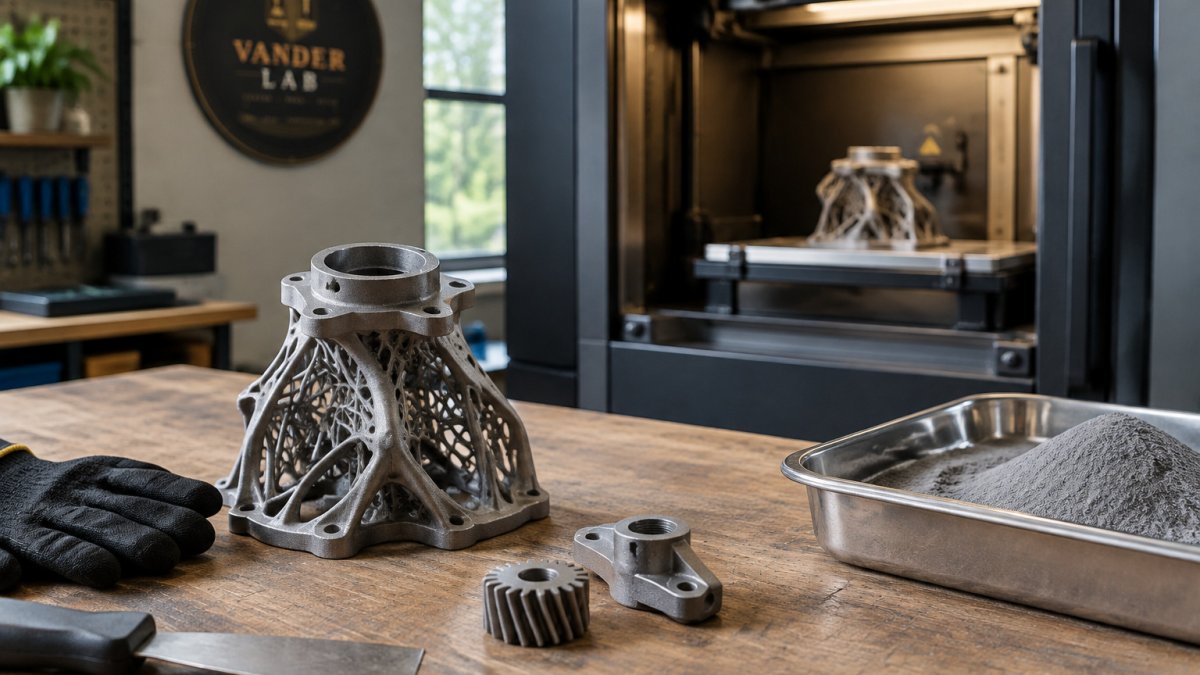
Yes, you can 3D print high-strength metal parts, and many are used in demanding jobs today, since modern 3D print metal processes now produce components that hold up well under real load. Metal 3D printing builds parts layer by layer from metal powder, fused with a laser or electron beam. For anyone asking whether it can make parts that hold up under real load, the answer is yes, with some important conditions. University of Wisconsin-Madison College of Engineering research on 3D-printed stainless steel
Here is what this guide covers:
- How strong printed metal really is, compared with traditional metal
- Why direction, density, and porosity change the results
- Which metal materials are common for strong parts
- How the main printing technologies differ
- How printed parts compare with CNC machined parts
- Which post-processing steps affect fatigue and finish
How Strong Is 3D-Printed Metal?
Printed metal can be very strong, but its strength depends on the alloy, the process, and the part design, so every 3D print metal project needs its own strength review. Researchers keep improving the materials. In one 2025 result from MIT, researchers reported a printable aluminum alloy that is five times stronger than cast aluminum and can withstand extreme temperatures, according to ScienceDaily coverage of MIT's printable aluminum alloy.
Strength varies a lot across materials.
Why Printed Strength Is Not Automatically Equal to Wrought Metal
Printed metal is not automatically as strong as wrought metal. Wrought means forged or rolled stock, and its published properties often do not transfer directly to printed parts.
Watch out: Never assume a printed part matches the datasheet of the same alloy in bar stock. Ask the manufacturer for test data on printed material.
Anisotropy, Density, and Porosity
Metal parts printed layer by layer are often stronger in some directions than others. This is called anisotropy. Loads applied across layers can behave differently than loads applied along them.
Density matters too. Even small pores can weaken a part under load, so process control and post-processing make a real difference.
Metal 3D Printing Materials for Strong Parts
Several metals are common for strong printed parts, and the choice matters more than most people expect. Common metals each have trade-offs that show up in yield strength, ductility, corrosion behavior, and how the alloy responds to printing and heat treatment:
- Stainless steel (17-4 PH and 316L): 17-4 PH is a precipitation-hardening grade that can reach high yield strength after aging, while 316L trades some strength for corrosion resistance and ductility. Both are common starting points for functional parts because they balance strength, corrosion resistance, and cost.
- Titanium (Ti-6Al-4V): Strong and light, with one of the best strength-to-weight ratios of any printed metal. It is common in aerospace and medical work where weight savings matter, but it is more expensive and harder to machine after printing.
- Inconel 718: A nickel-based superalloy that holds strength at high temperatures where aluminum and stainless steel soften. It is used for hot-section and exhaust components, and it is one of the harder alloys to post-process.
- Cobalt chrome: Wear resistance and strength for demanding parts such as cutting tools and medical implants. It holds up under abrasion better than most stainless grades.
- Aluminum (AlSi10Mg): Light weight and good thermal properties, useful for parts that need less load capacity or where mass is the constraint. It is not the choice for high-load structural parts.
Choose the material based on the load, heat, and environment the part will face. A part that sees cyclic loading at room temperature has different needs than one that sees steady load at 1,000°F. Our team at VanderLab can help you match the metal to the job. Our metal 3D printing materials guide lists the options that many engineers start with.
Reading Material Data the Right Way
Datasheets for printed alloys are often based on wrought or cast values, not on printed test coupons. That gap matters. A 17-4 PH part printed and aged may land in a different strength range than the same alloy in bar stock, and the difference depends on build orientation, powder batch, and heat treatment. Ask for test data from printed coupons in the orientation your part will see load, not just the alloy's generic datasheet.
A common pattern is that ductility drops before strength does. A printed alloy may match wrought yield strength while showing lower elongation, which changes how the part behaves under impact or overload. For load-bearing parts, compare both yield strength and elongation, not just the headline strength number.
For a design-focused look at how geometry affects load, read How to Design 3D Parts for Structural Strength. For a broader look at available options, see Best 3D Printing Materials for Functional Parts in 2026.
Metal 3D Printing Technologies: DMLS, SLM, and Binder Jetting
Three common processes in the industry are:
- DMLS (Direct Metal Laser Sintering): A laser sinters metal powder layer by layer. It is common for precise, functional parts.
- SLM (Selective Laser Melting): A laser fully melts the powder, which can produce very dense parts.
- Binder jetting: A liquid binder bonds the powder, and the part is then sintered. It can be faster but often needs more post-processing to reach full strength.
Each process suits different parts. If you need dense, load-bearing parts, DMLS and SLM are usually the starting points. The right choice depends on your geometry, material, and budget.
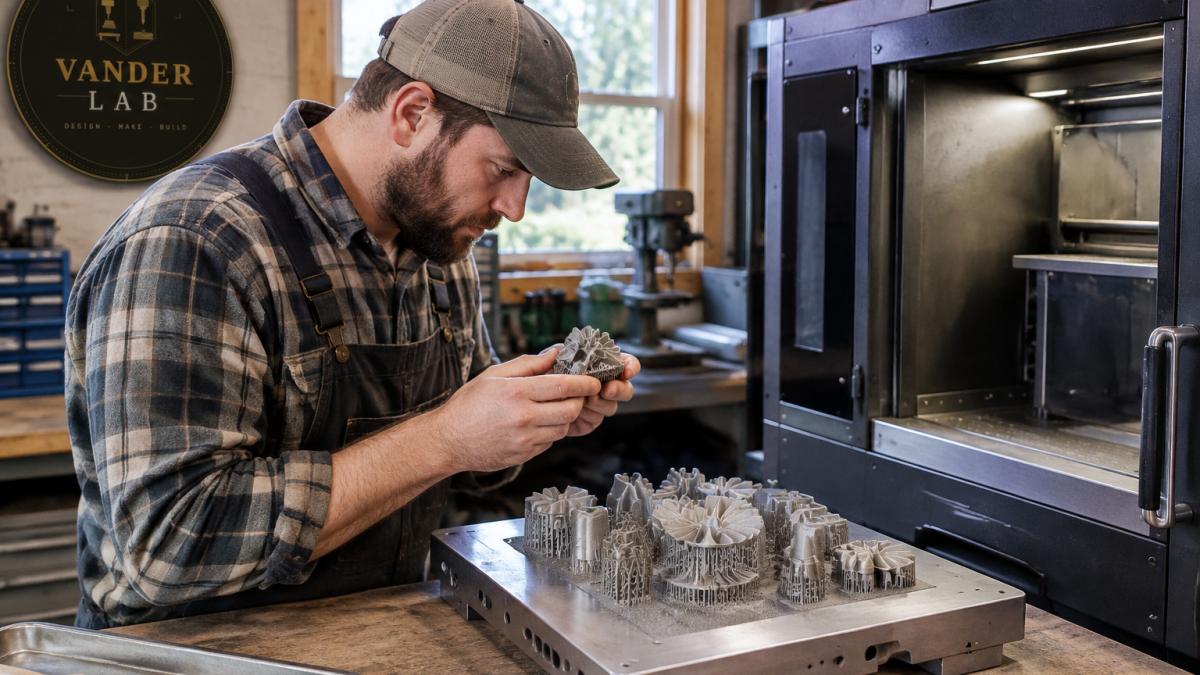
!Machinist in a small North Carolina workshop inspecting a freshly printed metal part on a build plate beside a metal 3D printer
3D-Printed Metal vs. CNC Machined Parts
Printed metal and CNC machined metal each have clear strengths. CNC machining starts with solid bar stock, so its properties are predictable and well documented. Printing builds the part from powder, which allows complex internal shapes that machining cannot reach.
Here is a quick comparison:
| Factor | 3D-Printed Metal | CNC Machined Metal |
|---|---|---|
| Complex internal shapes | Strong | Limited |
| Property predictability | Varies by process | Well documented |
| Surface finish | Rougher as printed | Smoother |
| Best for | Lightweight, custom geometry | Tight tolerances, known properties |
For many projects, the answer is a mix. Print the complex core, then machine the critical faces. For a deeper comparison, see CNC Machining vs 3D Printing for Prototypes: 2026 Guide.
Post-Processing, Fatigue, and Surface Finish Trade-Offs
Post-processing often decides how strong a printed part really is, and it is where most of the technical depth lives. Heat treatment can relieve internal stress and improve microstructure.
Fatigue Is the Failure Mode Most People Miss
High-strength parts often fail under fatigue, not under a single overload. A part that carries repeated loads can crack at stress points well below its static strength, and the crack usually starts at a surface feature or an internal pore. This is why a printed part that passes a static pull test can still fail in service after thousands of cycles.
Fatigue behavior is usually described with an S-N curve, which plots stress amplitude against the number of cycles to failure. Printed metals often show lower fatigue limits than wrought equivalents because of surface roughness and residual porosity, and the gap narrows after machining and HIP. If your part sees cyclic loading, ask for fatigue data, not just tensile data.
Surface Finish and Crack Initiation
Surface roughness, as printed, can start cracks. Rough surfaces create stress concentrations, and those concentrations become the initiation sites for fatigue cracks. Machining or polishing critical surfaces helps, and it is often the single highest-value post-processing step for a cyclically loaded part. Surface finish and structural integrity are related, but not the same. A smooth finish can hide internal flaws, and a rough finish can still be structurally sound if the part is not fatigue-critical. Plan post-processing around the part's real job.
Standards and Acceptance
Watch out: Skipping heat treatment or surface finishing on a load-bearing part can leave it weaker and more likely to fail in service, and skipping fatigue testing can hide a failure mode that static testing never catches.
For tolerance guidance on finished surfaces, see How to Ensure Tight Tolerances in Machining: 2026 Guide.
Planning Your Next High-Strength Metal Part
Start with the load, the temperature, and the environment. Then pick a material and process that fit those needs. Ask for printed-material test data and plan any post-processing up front.
A simple checklist helps:
- Define the load direction and the stress points
- Choose a metal suited to the heat and environment
- Confirm whether the process gives dense, printed-material data
- Plan heat treatment, HIP, or machining for critical surfaces
- Request a quote with your drawings or sketch
Ready to get started? Send us your sketch, photo, or rough idea, and we will help turn it into a print- or machine-ready file. Get a quote through our custom quotes page, or visit our eBay shop to see finished pieces. At VanderLab, we build precision parts one project at a time, right here in Mebane, North Carolina.
Frequently Asked Questions
How strong are 3D printed metal parts?
Strength depends on the alloy, the printing process, and the part's geometry. Printed metal is not automatically equivalent to wrought material, so printed properties may differ from published values. Request tested data for your specific material and build orientation before relying on a part under load.
Can metal parts be 3D printed?
Yes. Metal 3D printing is a recognized manufacturing method, and the right process and alloy depend on the application and the required performance.
How does the strength of 3D-printed metal compare with CNC-machined metal?
Strength comparisons depend on the alloy, the printing process, and the post-processing used. CNC machining starts from wrought stock, which often gives predictable properties. For critical parts, compare tested data for both routes and consider whether the geometry benefits from additive manufacturing.
What affects the strength of a metal 3D-printed part?
Key factors include alloy selection, density and porosity, build orientation, and heat treatment. Printed parts can behave anisotropically, meaning strength may differ between the build direction and other directions. Post-processing such as annealing or hot isostatic pressing can change microstructure and reduce porosity. Surface finish also matters because rough surfaces can create stress concentrations that reduce fatigue life.