 how-to
How to Get Custom Awards Engraved Locally
Table of Contents
- What You'll Need Before Commissioning Custom Awards Engraved Locally
- Types of Awards, Trophies, and Plaques to Consider
- Custom Laser Engraving Services: What the Process Actually Looks Like
- Personalized Award Design Tips That Get Better Results
- Small-Batch Custom Fabrication for Events and Organizations
- Local vs. Online: How to Decide Where to Order
- How to Get Custom Awards Engraved: Step-by-Step Summary
- Frequently Asked Questions
Last Updated: September 1, 2026
Getting custom awards engraved locally is simpler than most people expect, but results depend entirely on how well you prepare before contacting a shop. At VanderLab, we've worked through everything from single engraved trophies for disc golf tournaments to batch-produced keepsakes for community events. The same lesson shows up every time: people who get exactly what they envisioned arrived with a clear brief. Below, we'll walk through everything you need to know, from gathering your files and dedication text to choosing materials, understanding engraving methods, and deciding whether a local shop or online order makes sense for your timeline.
What You'll Need Before Commissioning Custom Awards Engraved Locally
Preparation is the part most guides skip, and it's the reason orders get delayed. Before you contact any shop, gather these essentials.
Dedication Text and Recipient Details
Write out the exact wording you want engraved, including the recipient's full name spelled exactly as it should appear, the award title, the date or year, and any organization name. Double-check every character before you send it. Keep the character count in mind, engraving precision decreases as text gets smaller. Ask your fabricator what the minimum legible font size is for your chosen material.
Logo and Artwork File Requirements
A logo vector file is the standard requirement for professional engraving results. Vector files, typically in .svg, .ai, .eps, or .dxf format, scale to any size without losing sharpness. Raster images like .jpg or .png can work for some laser engraving applications, but they need to be high resolution (300 dpi or higher), and results are less crisp than a clean vector (peer-reviewed research). If you only have a low-resolution logo, ask your fabricator whether they offer file conversion. VanderLab can work from photos or rough sketches and turn them into machine-ready files.
Types of Awards, Trophies, and Plaques to Consider
Custom awards engraved for recognition come in more forms than most people realize. The right type depends on the occasion, the recipient, and how the piece will be displayed.
Materials: Wood, Metal, Glass, and Crystal
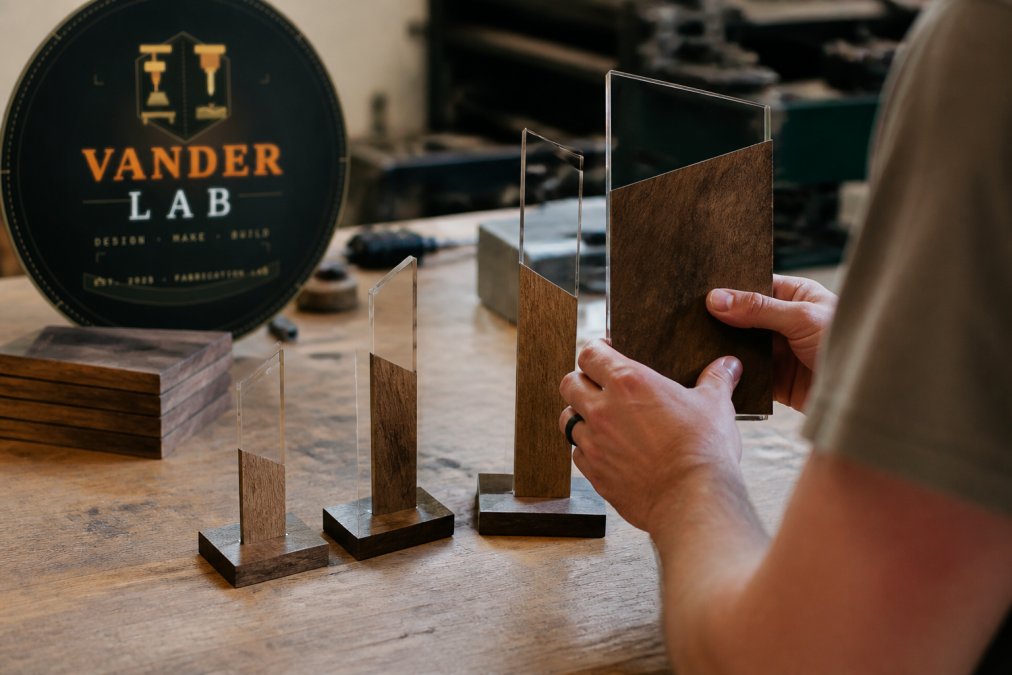
Wood is a warm, tactile choice for plaques and recognition pieces. Hardwoods like walnut and cherry hold detail sharply and age gracefully. Metal plates in aluminum, brass, and stainless steel are the standard for professional and corporate awards. Glass etching produces an elegant, frosted finish with fine detail. Crystal is the premium option, with optical clarity that makes engraved text and logos appear to float inside the piece.
Award Bases, Trophy Components, and Custom Inserts
Trophy components include the base, the column, and the figure or topper. A custom insert is the engraved plate or panel that carries the dedication text, typically mounted into a pre-made base. This is practical for organizations running annual awards: the base stays the same each year and only the insert changes. Award bases in wood, marble, or metal add weight and stability. VanderLab can machine a base from scratch when standard options don't fit the brief.
Custom Laser Engraving Services: What the Process Actually Looks Like
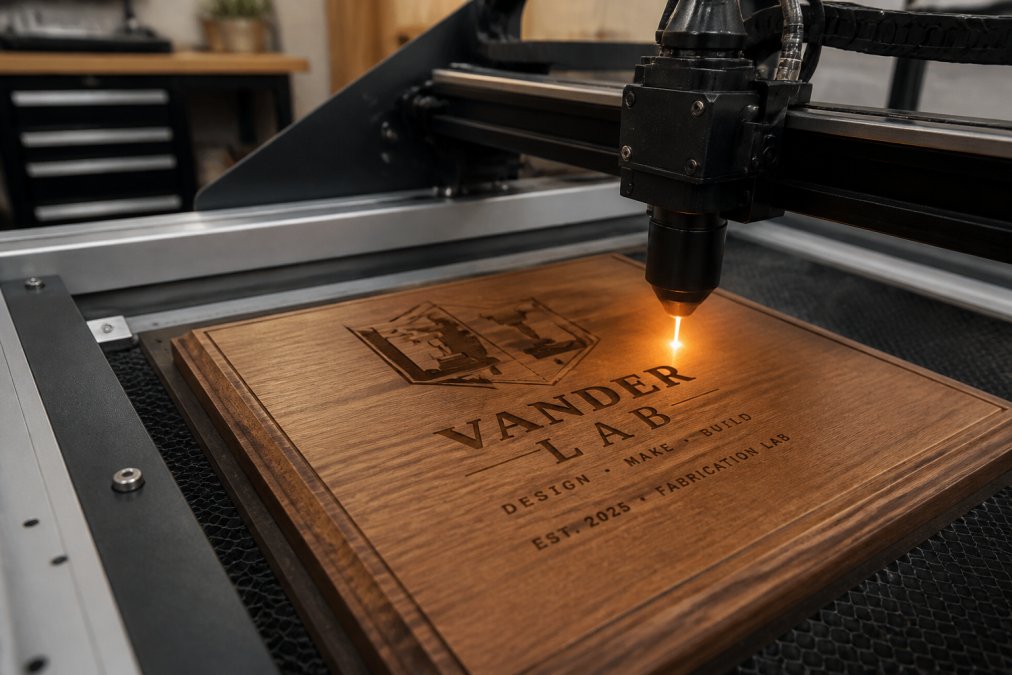
Custom laser engraving services use a focused beam of light to remove or alter the surface of a material, creating a permanent marking with precise depth and detail. The process is fast, repeatable, and well-suited to both text and complex artwork.
Laser Engraving vs. CNC Routing vs. Rotary Engraving
Laser engraving uses a high-powered beam to vaporize or char the surface. It's fast, highly precise, and handles fine detail well on wood, acrylic, leather, coated metals, and glass. CNC routing uses a spinning bit to physically cut into the material, creating greater depth and a more tactile result. Richard at VanderLab built his own CNC machine, which means the shop has direct control over tolerances and toolpath precision. Rotary engraving uses a spinning cutter designed for flat plates and cylindrical objects like pens or rings.
| Method | Best Materials | Engraving Depth | Detail Level | Typical Use |
|---|---|---|---|---|
| Laser Engraving | Wood, acrylic, glass, coated metal | Shallow | Very high | Plaques, photo engraving, fine text |
| CNC Routing | Wood, aluminum, dense plastics | Deep | High | Signage, thick plaques, 3D relief |
| Rotary Engraving | Metal plates, brass, aluminum | Medium | High | Name plates, trophies, pens |
| Sandblasting | Glass, stone, crystal | Variable | Medium | Glass etching, stone memorials |
The Design, Proof Approval, and Production Workflow
Most shops follow a consistent workflow: you submit your artwork and dedication text, the shop creates a layout design, you review and approve a proof, and production begins after approval. A proof is a digital mockup showing exactly how the engraving will be laid out on the piece, including font choice, sizing, and placement. Review it carefully and check every character of the dedication text against your original brief. Once production starts, changes are rarely possible without a full remake.
The layout design stage is also where engraving font selection happens. Serif fonts like Times New Roman read formally and suit corporate recognition. Sans-serif fonts like Helvetica work well for contemporary or athletic awards. Script fonts are elegant for keepsakes but can lose legibility at small sizes.
Personalized Award Design Tips That Get Better Results
Good personalized award design isn't about choosing the most elaborate option. It's about matching the piece to the moment.
Choosing Engraving Fonts and Layout Design
The most legible engraving fonts for plaques are clean, mid-weight faces with consistent stroke widths. Overly decorative fonts look impressive in a preview but lose detail in the actual engraving. Layout design should prioritize hierarchy: the recipient's name should be most prominent, followed by the award title, then the date and organization. A common mistake is trying to fit too much text at the same size, which produces a cluttered piece where nothing stands out.
How to Avoid Costly Mistakes Before Production Starts
The three most preventable errors in custom award production are text typos, wrong sizing, and file format problems. A short checklist before you submit your order eliminates most of them:
- Confirm the exact spelling of every name, title, and organization
- Verify the award dimensions suit the display location
- Supply artwork as a vector file or discuss conversion with the fabricator
- Specify the material and finish you want, not just the award type
- Confirm turnaround time and whether it fits your event date
- Review the proof against your original brief character by character
- Ask whether the setup charge covers revisions to the proof
Small-Batch Custom Fabrication for Events and Organizations
Small-batch custom fabrication is the right approach when you need more than one piece but not the volume that justifies a large commercial order. Schools, community organizations, sports leagues, and local events all fall into this category.
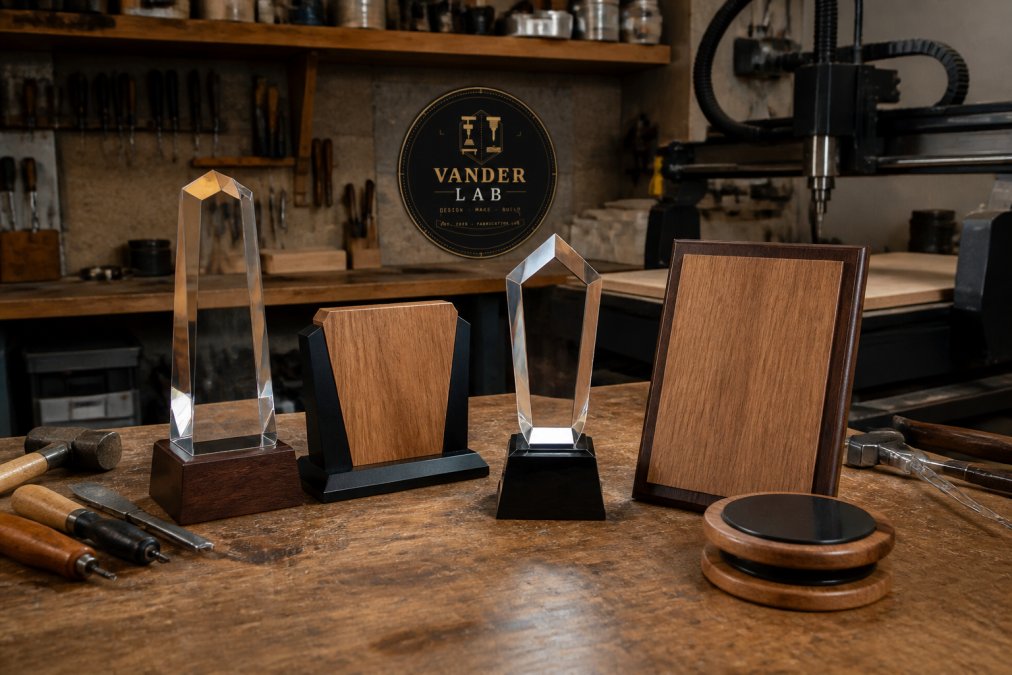
VanderLab has produced custom engraved trophies for a local disc golf tournament and batch-produced keepsakes for community events. Each run is built to spec, hand-finished, and checked before it ships or goes out for local pickup.
For organizations ordering annually, establishing a relationship with a local fabricator pays off. The fabricator already has your logo on file in the correct vector format, understands your preferred materials and finishes, and can turn around repeat orders faster than starting from scratch each time. A common approach is to keep the base award design consistent year to year and only update the custom insert with the current recipient's name and date.
Local vs. Online: How to Decide Where to Order
The right choice depends on your timeline, your need for hands-on communication, and whether the piece is complex enough to benefit from in-person review.
Vetting a Local Shop Before You Commit
A local shop gives you something an online order can't: the ability to see samples of actual work before you commit. When vetting a local fabricator, ask to see examples of engraving on the specific material you're planning to use. A shop that can show you finished pieces rather than just digital mockups is giving you a much more reliable preview of your result. Ask about their in-house production capabilities and whether they handle proof approval in writing or verbally. Written proof approval protects both parties.
Turnaround Times, Shipping Lead Times, and Bulk Pricing
Turnaround time for a single custom award from a local shop typically runs two to five business days once proof approval is complete (sba.gov). Rush orders are often available for a premium. Local orders you can pick up the day they're finished will almost always beat an online order for tight deadlines. For online orders, build in a buffer of at least three to five business days beyond the stated production time. Many shops offer tiered discounts starting at quantities of six to ten pieces (nfib.com). If you're ordering for an annual awards program, ask whether the shop offers a standing order arrangement.
How to Get Custom Awards Engraved: Step-by-Step Summary
Getting custom awards engraved well comes down to a clear sequence:
- Define the award type and material - Choose between plaque, trophy, glass, crystal, or metal plate based on the occasion and display context.
- Write out the exact dedication text - Include the recipient's full name, award title, date, and any organization name. Spell-check everything.
- Prepare your artwork - Supply a logo vector file in
.svg,.ai,.eps, or.dxfformat. If you only have a raster image, discuss conversion with your fabricator. - Contact your fabricator with a full brief - Include material preference, dimensions, quantity, event date, and all text and artwork.
- Review the proof carefully - Check every character of dedication text, confirm logo placement and font choice, and request any adjustments before approving.
- Confirm turnaround time and pickup or shipping details - Get the production completion date in writing relative to your event date.
- Approve the proof in writing - Email confirmation creates a clear record of what was approved.
- Inspect the finished piece on receipt - Check engraving depth, text accuracy, and material finish before the award ceremony.
| Project Type | Recommended Method | Key Consideration | Best Material |
|---|---|---|---|
| Single milestone award | Local fabricator | Proof review critical | Wood or crystal |
| Annual organization trophies | Local with standing order | Consistent template saves time | Metal plate + wood base |
| Event keepsakes, batch run | Small-batch fabrication | Per-piece cost efficiency | Wood or acrylic |
| Outdoor plaques | Local CNC or rotary | Material durability priority | Aluminum or brass |
| Formal corporate recognition | Local or online | Vector file required | Glass or crystal |
Finding a fabricator who takes the brief seriously and communicates clearly through the proof process matters most. VanderLab handles custom engraved awards, plaques, trophies, and keepsakes from concept to finished piece, working from sketches, photos, or rough ideas and turning them into machine-ready files cut on equipment built in-house. Local pickup is available in Mebane, and shipping is available nationwide. Shop custom awards and personalized pieces at VanderLab and Carolina Crafted Van, and get something made with intention rather than pulled off a shelf.
Frequently Asked Questions
How long does the custom engraving process typically take?
Turnaround time varies by shop and order size. A single custom award engraved locally can often be ready in two to five business days once proof approval is complete. Bulk orders for events or organizations may require more time. Rushing an order is sometimes possible but may carry an additional fee. Always confirm the shipping lead time or local pickup window before you finalize your order, especially for an upcoming award ceremony.
What materials are best for custom engraved awards?
Wood, metal plates, glass, and crystal are common choices for custom awards engraved for recognition events. Wood offers warmth and is well suited to laser engraving and CNC routing, producing clean, deep results. Metal gives a formal, permanent marking that holds up over time. Glass etching and crystal produce a polished, high-end appearance for achievement medals and executive awards. The right material depends on the occasion, the recipient, and how the piece will be displayed.
How do I prepare a design file for laser engraving?
Most custom laser engraving services request a vector file, typically an SVG, AI, or EPS format, so the artwork scales without losing precision. If you have a logo, ask your designer for the original vector file rather than a JPEG or PNG. For text-only dedications, the shop can usually set the engraving font and layout design from your written instructions. Always review the proof before production starts to catch any typos or spacing issues in the dedication text.
What is the difference between CNC routing and laser engraving for awards?
Laser engraving uses a focused beam to mark or remove material from the surface, making it ideal for fine detail, photographs, and glass etching. CNC routing uses a physical cutting bit to carve into the material, which produces greater engraving depth and a tactile, dimensional finish well suited to wood and metal plaques. For most personalized trophies and custom plaques, laser engraving can offer finer text detail, while CNC routing is often chosen when you want a raised or deeply carved design element.
This article was written using GrandRanker