 listicle
Best Materials for Custom 3D Printed Enclosures
Table of Contents
- Quick Comparison: Best Materials for 3D Printed Enclosures
- PLA: Easiest to Print, Weakest Against Heat
- PETG: The Everyday Workhorse for Functional Enclosures
- ASA: UV Stability and Structural Rigidity for Outdoor Use
- Polycarbonate: Maximum Impact Resistance and Heat Tolerance
- Acrylic, Polycarbonate and Coroplast: Choosing Enclosure Panels
- MDF, Hardboard and Aluminum Extrusion: Frame Construction Materials
- How to Avoid Layer Lines in 3D Printing Enclosure Parts
- Frequently Asked Questions
Last Updated: September 18, 2026
Quick Comparison: Best Materials for 3D Printed Enclosures
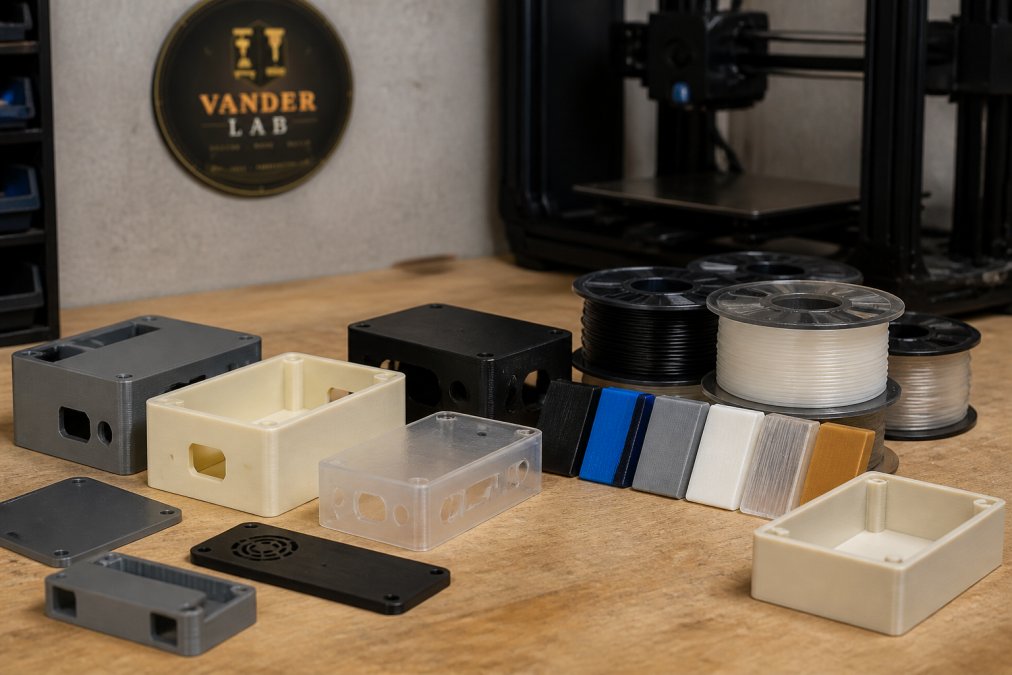
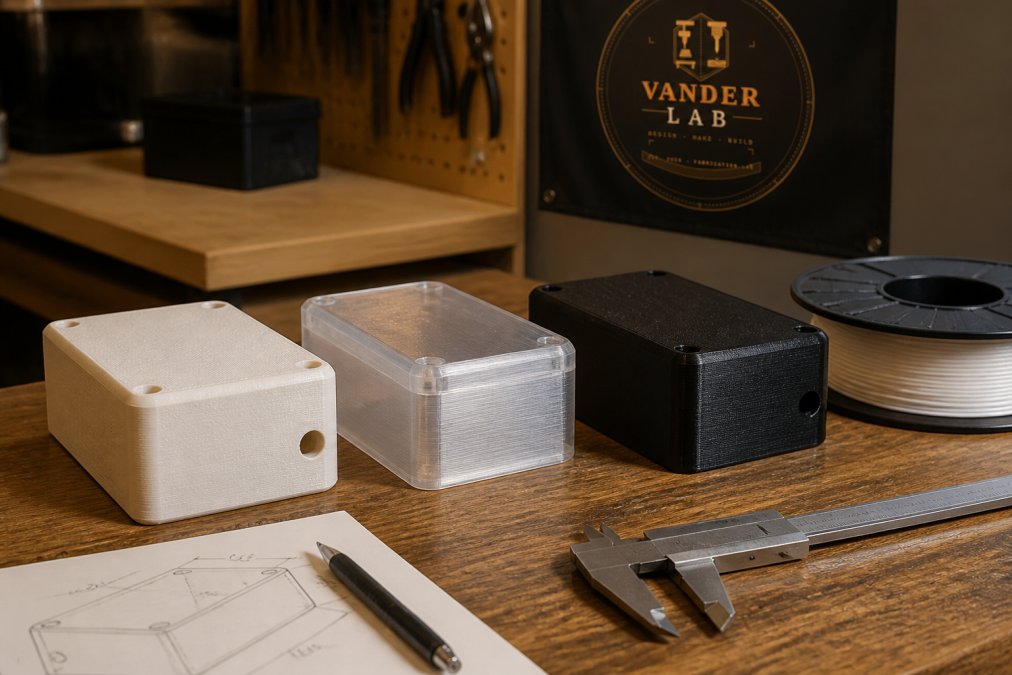
Choosing the best materials for custom 3D printed enclosures comes down to three questions: how hot the environment gets, whether it sits indoors or out, and how much impact it needs to survive. PLA is the easiest starting point, PETG handles most everyday jobs, ASA resists sunlight, and polycarbonate takes the hardest hits.
This guide from VanderLab walks through each option, plus the panel and frame materials that finish the job. Below, we'll show you exactly which filament fits which project, and where most builders go wrong.
| Material | Heat Resistance | UV Stability | Impact Strength | Best For |
|---|---|---|---|---|
| PLA | Low | Poor | Moderate | Prototypes, indoor projects |
| PETG | Moderate | Fair | Good | Functional indoor enclosures |
| ASA | High | Excellent | High | Outdoor, sun-exposed housings |
| Polycarbonate | Very high | Good | Exceptional | Industrial, high-impact use |
| Acrylic panels | Moderate | Good | Low | Clear visibility windows |
| Coroplast | Low | Fair | Low | Budget DIY walls |
PLA: Easiest to Print, Weakest Against Heat
PLA is the friendliest filament for anyone new to 3D printed enclosures, and it's the one we recommend for early prototypes. It prints clean, holds tight tolerances, and resists warping better than almost anything else.
The catch is heat. PLA softens at relatively low temperatures, so an enclosure sitting in a hot car or near a heat source can sag or deform. Warping prevention matters here too: thin PLA walls on a large enclosure can bow over time.
- Pros: Very easy to print, low cost, sharp detail
- Cons: Low heat resistance, poor for long-term outdoor use
PETG: The Everyday Workhorse for Functional Enclosures
PETG is the material most people should reach for first. It balances the printing ease of PLA with much better durability, and it doesn't demand a fully enclosed printer.
Its chemical resistance and layer adhesion make it a solid choice for functional housings that see daily handling. The trade-offs are real: PETG strings more than PLA, and it flexes slightly under load, so it's less rigid.
- Pros: Durable, good impact strength, forgiving to print
- Cons: Prone to stringing, less rigid than PLA
ASA: UV Stability and Structural Rigidity for Outdoor Use
ASA is the pick when an enclosure lives outside. It resists UV degradation, holds its color, and won't yellow or crack the way PLA and PETG eventually can.
The trade-off is process control. ASA needs an enclosed printer and stable ambient temperature to prevent warping, and it costs more than standard filaments. Get the setup right and you get a housing that survives seasons of sun and rain.
Polycarbonate: Maximum Impact Resistance and Heat Tolerance
Polycarbonate delivers the toughest result on this list. It shrugs off impact, tolerates high heat, and holds up in industrial settings where a cracked housing isn't an option.
It's also the hardest to print. Polycarbonate needs high nozzle and chamber temperatures, dries aggressively, and punishes any moisture in the filament. For most home builders, it's overkill. For a part that gets knocked around or runs hot, nothing else comes close.
Acrylic, Polycarbonate and Coroplast: Choosing Enclosure Panels
Panel material decides three things at once: how much you can see inside, how much structure the walls add, and how the enclosure behaves when something goes wrong. Most guides stop at clarity. The real decisions live in thickness, fire behavior, chemical exposure, and how the panel meets the frame.
Acrylic (PMMA) offers the best optical clarity of the three and takes a clean, professional edge on a CNC router. It is also the most brittle. A 1/8 in. acrylic window is fine for a small electronics housing, but a 24 in. span will flex and eventually craze at the mounting holes. Drill with a plastic-specific bit, keep holes at least one diameter from the edge, and let the panel float in oversized holes so it can expand. Acrylic is sensitive to solvents: isopropyl alcohol, acetone, and many aerosol cleaners will fog or crack it over time. Wipe with mild soap and water instead.
Polycarbonate (PC) trades a little clarity for impact resistance that acrylic cannot match. A 1/8 in. polycarbonate panel will absorb a dropped tool or a shop accident that would shatter acrylic.
| Panel | Typical Thickness | Clarity | Impact | Fire Behavior | Chemical Notes |
|---|---|---|---|---|---|
| Acrylic (PMMA) | 1/8 in. to 1/4 in. | Excellent | Low | Burns; not fire-rated | Fogs with alcohol and acetone |
| Polycarbonate | 1/8 in. to 1/4 in. | Good | Exceptional | Burns; not fire-rated | Tolerant of most shop chemicals |
| Coroplast | 4 mm to 10 mm | Poor | Low | Melts and drips | Limited resistance |
For visibility, acrylic. For toughness and chemical exposure, polycarbonate. For a first mockup, Coroplast. For fire safety, none of the three, so plan the rest of the enclosure accordingly.
MDF, Hardboard and Aluminum Extrusion: Frame Construction Materials
Frame material carries the enclosure's weight, sets its rigidity, and quietly decides two things most guides never mention: how much noise escapes and how much heat the walls themselves conduct away from the chamber.
| Frame | Rigidity | Weight | Moisture | Acoustic Value | Thermal Bridging |
|---|---|---|---|---|---|
| MDF | Good | Heavy | Swells | High | Low |
| Hardboard | Low | Light | Swells | Low | Low |
| Aluminum extrusion | Excellent | Moderate | None | Low alone; high with lining | High |
If noise is the goal, build the frame rigid and line the inside with a soft, closed-cell layer. If heat retention is the goal, insulate the outside of a metal frame rather than switching to wood, so you keep the rigidity without losing the chamber temperature.
How to Avoid Layer Lines in 3D Printing Enclosure Parts
Layer lines are a cosmetic and functional issue, and avoiding them starts before the print. For enclosure faces, orient the part so the most visible surface runs parallel to the build plate, which hides layer stacking on the front.
A few practical fixes:
- Lower layer height for finer surface detail on visible faces
- Tune extrusion and temperature to reduce visible banding
- Sand and prime parts that will be painted
Frequently Asked Questions
What is the best material to use for a 3D printer enclosure?
It depends on where the enclosure lives. PETG handles most indoor functional enclosures well because it balances impact strength, chemical resistance and printability. For outdoor use or anywhere sunlight hits daily, ASA holds up far better thanks to its UV stability and higher heat resistance. PLA works for prototypes and short-term projects but softens in a hot car or direct sun. Match the material to the environment, not the other way around.
Is PLA or PETG more durable for custom 3D printed enclosures?
PETG wins on durability for most real-world enclosure use. It has better impact resistance, handles chemicals more gracefully, and tolerates warmer ambient temperatures than PLA. PLA is stiffer and prints cleaner, which makes it great for display pieces and quick mockups, but it becomes brittle over time and deforms in heat. If the enclosure will be handled, dropped or left near electronics that warm up, choose PETG.
Why is thermal stability important for custom 3D printed enclosures?
Electronics generate heat, and enclosures trap it. If the material softens below the chamber temperature, walls warp, screw bosses strip and gasket sealing breaks down. PLA starts losing rigidity around 60°C, while PETG and ASA hold shape higher. For boards that run warm or sit in sunlight, pick a filament rated above the expected internal temperature, and add ventilation control so heat escapes instead of building up.
How do you ensure structural integrity in custom 3D printed housings?
Start with the right material density and wall thickness for the load, then reinforce corners with fillets and ribs instead of thick solid walls. Use consistent layer heights, avoid sharp internal corners, and add mounting bosses with enough wall count to resist stripping. On larger housings, a metal frame or aluminum extrusion skeleton carries the load while the printed shell handles fit and finish. Test-fit hardware before final assembly.
What are the benefits of using ABS versus PETG for electronics enclosures?
ABS offers higher heat resistance and a slightly stiffer finished part, which suits enclosures that sit near warm components. It also sands and smooths easily for a painted finish. PETG is easier to print, has better layer adhesion, and resists chemicals better, but it flexes more and can string during printing. If you need heat tolerance and plan to post-process, ABS works. If you want a durable part without an enclosed printer, PETG is the simpler path.
Custom enclosures live or die on material choices made early. Match the filament to heat, sunlight, and impact, then pick panels and frames that support the job. VanderLab builds precision parts and enclosures from concept to finished piece, with custom CNC machining, 3D printing, and CAD design, plus local pickup in Mebane and shipping nationwide. Get started with VanderLab and turn your rough sketch into a built-to-spec enclosure that lasts.