 comparison
Alternatives to Plastic Wall Mounts for Heavy Wooden Signs
Table of Contents
- Why Plastic Wall Mounts Fall Short for Heavy Wooden Signs
- How to Hang a Heavy Wooden Sign Using Wall Studs
- French Cleat for Wooden Sign Mounting
- Hanging Heavy Objects on Drywall Without Studs
- Custom Wood Mounting Plates and Rabbeted Trim
- Metal Hardware and Picture-Frame Hangers
- Choosing the Right Method for Your Sign and Wall
- Frequently Asked Questions
Last Updated: October 15, 2026
Why Plastic Wall Mounts Fall Short for Heavy Wooden Signs
Plastic wall mounts are fine for lightweight frames, but hang a heavy wooden sign on one and the plastic isn't designed for the sustained load. The anchor point eventually fails, a slow slide or a sudden crash.
This is where alternatives to plastic wall mounts for heavy wooden signs become essential.
Several proven methods work reliably for heavy wooden signs: using the wall structure itself, heavy-duty load-bearing fasteners, or custom-built hardware that spreads weight across a wider area.
How to Hang a Heavy Wooden Sign Using Wall Studs
The strongest option is mounting directly to wall studs, the vertical framing members behind your drywall, typically spaced 16 inches apart. Made of solid wood or metal, they support significant weight when fastened properly.
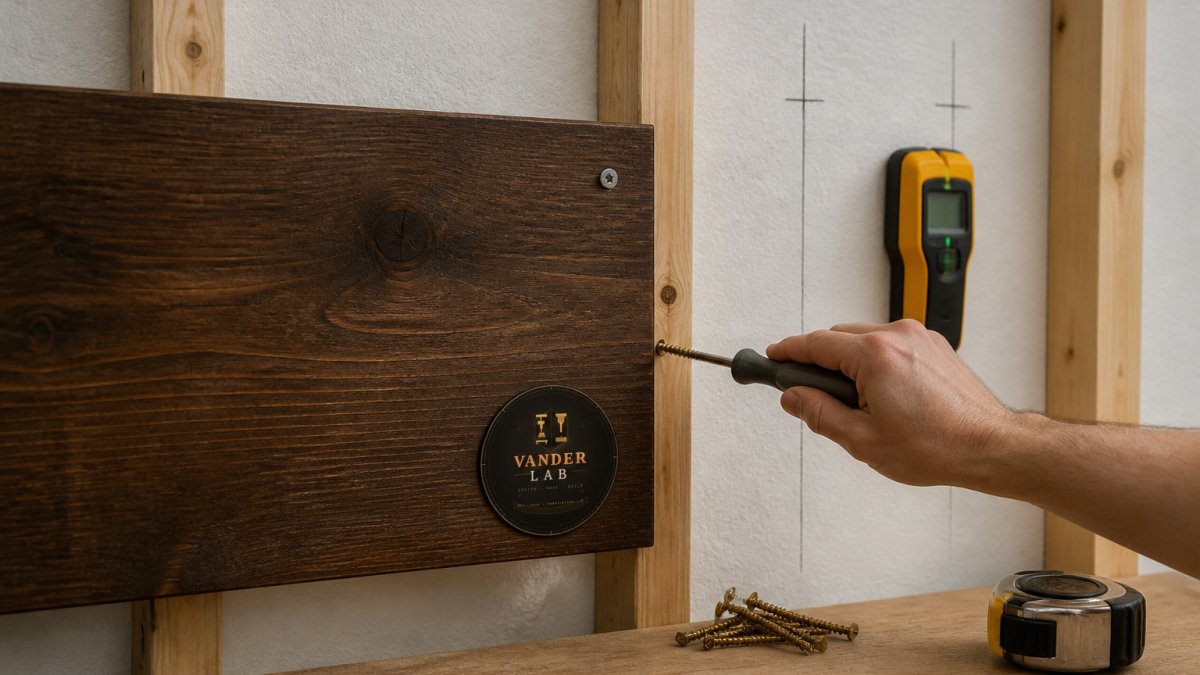
Finding studs and securing fasteners
Locate the studs with a stud finder and mark them. For a heavy sign, anchor into at least two studs, planning fastening points so the studs fall within or near the mounting area.
Use wood screws rated for structural fastening, framing screws have higher shear strength and grip wood fiber better than nails. Drill a pilot hole slightly smaller than the screw diameter to prevent splitting, then drive the screw through your hardware and into the stud.
Load distribution across multiple studs
The key to a reliable installation is spreading weight across multiple fastening points. A single screw into one stud creates a stress concentration; two screws into two studs share the load and provide redundancy, so if one fails, the other holds.
Position fasteners roughly equidistant from the center of gravity to prevent tilting. For signs wider than 24 inches, use four fasteners across two studs, the extra hardware costs almost nothing and dramatically improves reliability.
French Cleat for Wooden Sign Mounting
A French cleat separates the mounting hardware from the sign itself. Two interlocking pieces of wood, each cut at a 45-degree angle, lock together like a puzzle, one mounts to the wall, the other to the back of your sign. It works well for custom wooden signs and allows easy removal without wall damage.
How the cleat system works
The wall-mounted cleat points upward at a 45-degree angle; the cleat on the back of the sign has a corresponding slot that slides down over it. When seated, the angled surfaces create a mechanical interlock that distributes load across the cleat's entire length.
The angled geometry converts the sign's downward force into a horizontal force pressing the cleats together, so compression strengthens the connection rather than weakening it.
Installation and weight capacity
Mount the wall cleat level into studs with wood screws, positioned where you want the top of your sign to sit.
Capacity depends on cleat thickness, length, and fastener quality. A properly installed system with 0.75-inch-thick lumber and fasteners into solid studs reliably supports signs of 50 pounds or more. The longer the cleat, the better the weight distribution.
Hanging Heavy Objects on Drywall Without Studs
Sometimes studs don't line up with where you want the sign. Then you need fasteners designed for hollow-wall applications. Molly bolts and toggle bolts are two proven alternatives to plastic wall mounts for heavy wooden signs, but the gap between a rated capacity and one you can trust is where most installations go wrong.
Molly bolts and toggle bolts explained
Molly bolts use a threaded anchor that expands behind the drywall as you tighten, creating a mechanical lock that spreads load across a larger area. Toggle bolts use spring-loaded wings that flip open behind the wall.
A common failure pattern is treating the package rating as the working load. Ratings are tested under ideal conditions, new drywall, correct hole size, no vibration, no wind.
Spacing fasteners for even weight distribution
Don't rely on a single molly or toggle bolt for a heavy sign. Use at least two, spaced as far apart as practical, on a 30-inch sign, place them 24 inches apart. The greater the distance between fasteners, the less stress on each anchor.
For signs heavier than 20 pounds, use three fasteners in a triangle pattern, which resists tilting and handles uneven loads better than a two-point mount. Check the load rating of your specific fasteners.
Sign-specific load distribution
A wooden sign isn't a flat picture frame. Its thickness and mass put the center of gravity forward of the wall, creating leverage, a pulling force at the top fasteners and a pressing force at the bottom.
For a sign wider than 24 inches, horizontal span matters as much as weight. Spreading fasteners toward the outer edges, while keeping them within the mounting area, reduces bending stress and keeps the bottom edge level.
Removability and wall repair
Molly and toggle bolts aren't forgiving if you plan to move the sign later. Toggle bolts leave a hole roughly the size of the folded wings, and the anchor often drops into the wall cavity when removed.
If removability matters, a rental, a seasonal sign, a piece you may relocate, a French cleat or picture-frame hanger leaves a smaller, more predictable repair, though those methods generally need studs or a heavier wall to reach the same capacity.
Custom Wood Mounting Plates and Rabbeted Trim
For a truly built-to-last installation, a custom wood mounting plate offers precision and durability.
A mounting plate is typically 0.75 inches thick and at least 2 inches wide, running horizontally across at least two studs.
Some builders use rabbeted trim, wood trim with a notched lip, as a mechanical stop that prevents sliding. The lip sits outboard of the sign, so even if fasteners failed, the sign would rest on it.
The trade-off: a custom mounting plate requires carpentry skills or a professional fabricator, and it isn't a five-minute installation. If you're ready to explore a precision-built mounting system for your sign, get a custom quote and let's build something built to last.
Metal Hardware and Picture-Frame Hangers
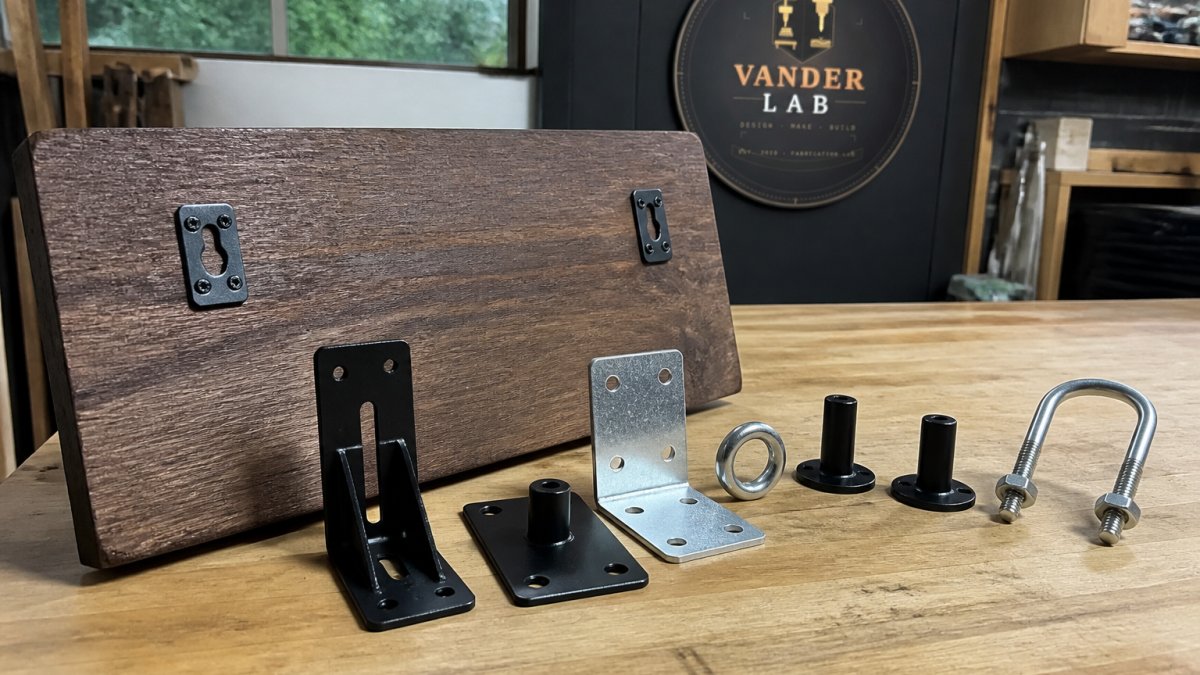
Picture-frame hangers and heavy-duty metal hardware, D-rings, eye bolts, and specialized load-bearing picture hangers, are another category of alternatives to plastic wall mounts for heavy wooden signs. Here the gap between what a package claims and what a heavy wooden sign actually needs is widest.
Picture-frame hangers and wire vs. strap
Picture-frame hangers mount to the wall and support the sign via a wire or strap on the back. Heavy-duty versions support 50 pounds or more.
The wire-versus-strap choice matters more for a wooden sign than a framed print. A braided wire under load forms a shallow V, and tension rises as the V gets shallower, a heavy sign on a long wire can put several times its own weight of tension on the wire and hanger.
D-rings and eye bolts
D-rings and eye bolts fasten to the back of the sign and hang on hooks mounted to the wall. The hardware is inexpensive and installation is quick, making this a practical choice for signs that need to be removable or repositionable.
In a D-ring setup, the weak point is usually the screws holding the D-ring to the sign, not the D-ring itself.
Matching hardware to sign weight and wall type
A simple way to choose is to work from the sign's weight and the wall behind it:
- Under 20 pounds, studs available: a single heavy-duty picture hanger into a stud is often enough.
- Under 20 pounds, no studs: a pair of D-rings on two hooks anchored with toggle bolts spreads the load and stays removable.
- 20 to 50 pounds, studs available: a strap-and-D-ring setup or a French cleat into studs handles the load with margin.
- Over 50 pounds, or any outdoor sign: a cleat or a custom mounting plate fastened across multiple studs is the safer route; metal hangers alone are working near their limits.
Outdoor and environmental considerations
A sign on a porch, fence, or garage wall faces conditions a picture never does. Moisture, temperature swings, and wind work on the hardware over time. Wind is the underrated one: gusts push and pull on the sign's face, transferring a repeated, reversing load to the hanger and fasteners. Hardware that's fine indoors can loosen outdoors.
For outdoor installations, choose corrosion-resistant hardware, stainless steel or hot-dip galvanized, and check fasteners periodically. Tightening a backing-out fastener now is easier than repairing a fall later.
Where this category fits
Metal hangers and D-rings aren't the strongest option here, but they're the most flexible. They suit signs that will move, walls where studs are hard to reach, and spots where a hidden cleat isn't practical. Used within their real capacity and with fasteners sized for the sign's thickness, they're a reliable alternative to plastic wall mounts. Used at the edge of their rating on a heavy sign, they're the setup most likely to fail quietly over time.
Choosing the Right Method for Your Sign and Wall
The best mounting method depends on three factors: your wall type, your sign's weight, and your permanence preference.
If studs align with where you want the sign, use them with wood screws, the strongest, most straightforward option.
For signs under 20 pounds on walls without accessible studs, molly or toggle bolts work reliably.
The common mistake is underestimating weight, a wooden sign that looks modest in the workshop gets surprisingly heavy in solid wood.
A heavy wooden sign deserves mounting hardware that matches its craftsmanship. Browse our eBay Shop for ready-made options, or get a custom quote for a mounting system built exactly for your project.
Frequently Asked Questions
What can I use instead of plastic wall mounts for a heavy wooden sign?
Several durable alternatives work better than plastic anchors for heavy wooden signs. Mounting directly into wall studs using wood screws provides the strongest support. French cleats distribute weight across a wider area and allow easy removal. For drywall without studs, molly bolts and toggle bolts offer better holding power than plastic sleeves. Custom wood mounting plates fastened across multiple studs, or metal picture-frame hangers rated for your sign's weight, also provide reliable non-plastic options.
How do I hang a heavy wooden sign on drywall when there is no stud?
Use multiple fasteners spaced evenly across the sign's mounting surface to distribute weight. Molly bolts and toggle bolts are rated for hollow-wall applications and hold better than plastic anchors. Install at least two fasteners, and three or four if your sign is particularly heavy. Space them 16 to 24 inches apart horizontally. Verify each fastener's weight rating and ensure the combined capacity exceeds your sign's weight. A French cleat mounted to studs above the drywall area also works well, allowing the sign to hang from the cleat rather than relying solely on drywall fasteners.
Can I hang a heavy wooden sign directly into a wall stud?
Yes, and it's one of the strongest methods available. Use wood screws sized appropriately for your sign's weight and the stud's thickness, typically 2.5 to 3.5 inches long for standard studs. Drill a pilot hole first to prevent splitting, then drive the screw at a slight downward angle. If your sign is very heavy, use multiple screws across its mounting surface, spacing them 16 inches apart to align with stud spacing. This method transfers the full load directly to the framing, eliminating reliance on wall anchors or fasteners.
Are French cleats a good choice for heavy wooden signs?
French cleats are excellent for heavy wooden signs because they distribute weight across a wide mounting surface and allow for easy removal without wall damage. A French cleat consists of two pieces of wood cut at matching 45-degree angles, one fastened to the wall studs, the other attached to the sign's back. The sign simply hooks onto the wall-mounted cleat and hangs securely. This method works well for signs you might want to reposition or remove later, and it handles substantial weight when properly installed into studs.